Campaigners watchful as Greens take over Lewisham Pensions Investment Committee
The new chair of the PIC is Green councillor Ed Sutton, a leading local campaigner for divestment for Palestine. But recent pension reforms create new challenges for divestment.
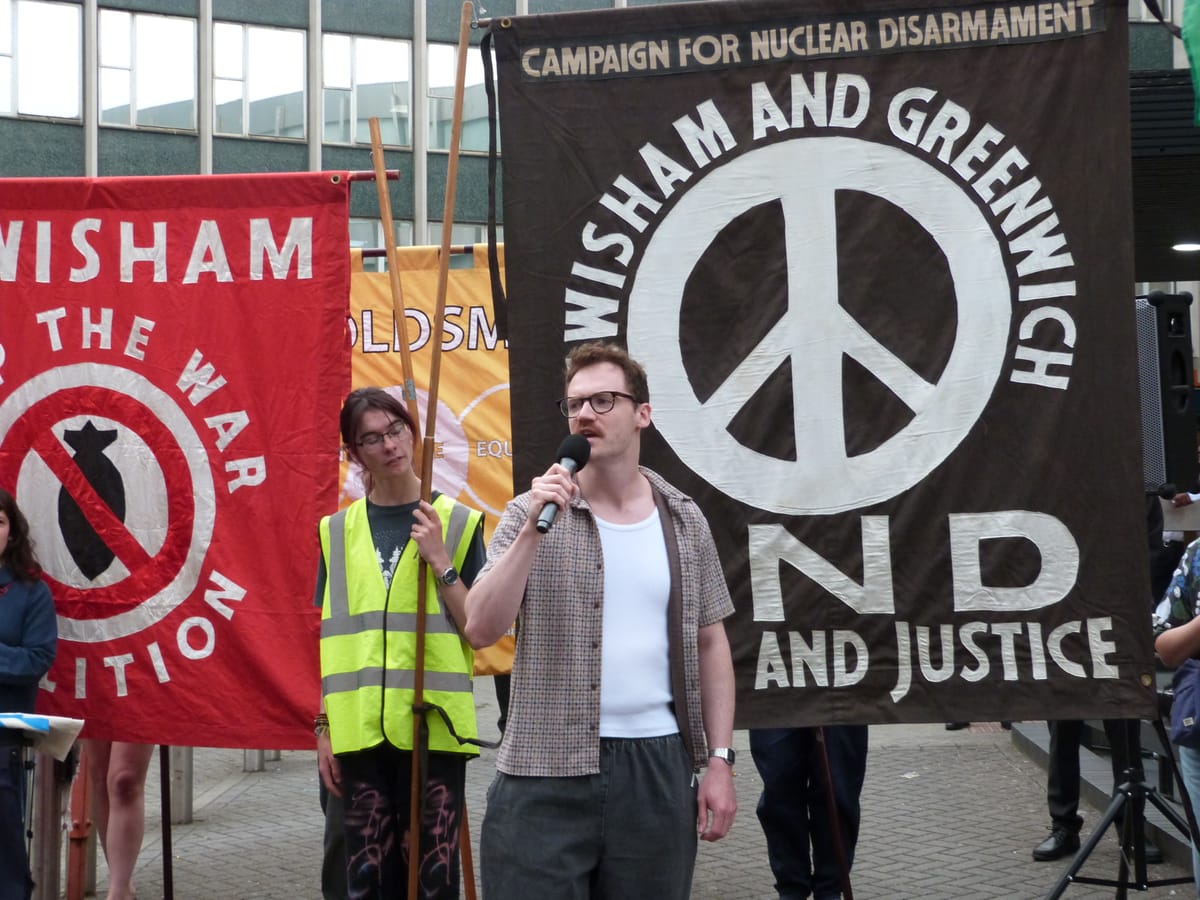
Peace campaigners were watching like hawks at the first meeting of the Pensions Investment Committee under the new Green majority administration.
The committee is now chaired by Ed Sutton who, as he said in the meeting, has moved from the public gallery to "the opposite side of the table".
The committee has eight councillors - six Greens including Sutton and two Labour councillors - Oana Olaru-Holmes and Gloria Lambert-Morris.
Public and press were not allowed into the civic centre or even to stand outside it until a few minutes after the meeting was due to start, although once inside the committee room we all behaved ourselves with no heckling.
Prior to the local elections, the government brought in new pensions regulations which have changed the level of control that councils have over their pension funds.
London councils had to move all of their funds into the London Collective Investment Vehicle (LCIV) by the end of March 2025, leading to heightened concerns about individual councils' power to divest for Palestine.
Lewisham council finance director Katharine Nidd introduced the LCIV team who attended remotely, saying it was "a great opportunity for the committee to engage with our fund manager .. and put questions to them."
Martin Gloyne, director of operations at London CIV, gave an overview of the changes that now apply to Lewisham's local authority pension fund.
Local government pension scheme pooling began with Conservative government reforms in 2015, he said, with an aim of "gaining strength from creating a single pool to negotiate with investment management capabilities, but also to drive investments into the private market".
London CIV was formed in 2016. The Labour government's introduced its "Fit for the Future" reforms in November 2024 which have led to mandatory pooling and a reduction in the number of pools from eight to six.
"Each partner fund (local authority pension scheme) has their own priorities and retains control over strategic direction .." Gloyne said.
"But the direction across all authorities and across London CIV is to get greater scale .. and more consistent returns by rationalising and pooling those investment propositions."
LCIV is effectively an asset manager of £60bn with 33 clients (London authorities and Buckinghamshire) and can leverage scale and negotiating power, he said.
He provided examples of LCIV investing in affordable housing through the UK housing fund.
Support local independent journalism from just £2 per month or leave a tip.
Responsible investment in conflict zones
The focus of interest for the committee and campaigners was the Responsible Investment statement.
Gloyle explained that partner funds (ie individual pensions schemes) remain responsible for their own Investment strategy statement and Responsible Investment statement, but that LCIV is expected to provide advice.
He explained the responsible investment approach for divestment from fossil fuels, saying that LCIV is targeting Net zero 2040 for public assets but that private assets are "more problematic in setting targets but .. more aligned to actual strategies".
A recent investigation by The Bureau of Investigative Journalism, shared with Salamander, found that Lewisham pension fund has over £77m invested in private funds with large oil and gas holdings.
Government statement on boycotts, divestments and sanctions
Gloyne said the team had recently added a slide to the overview - a letter from Alison McGovern MP from 12 May 2026 stating the government's view on Responsible Investment decision making in conflict zones.
It states: "The government's position is clear: decisions on boycotts, divestment and sanctions are for UK Government, not local authorities.
"It is therefore not appropriate for local authorities to adopt investment policies that go beyond or differ from UK government sanctions or foreign policy positions."
He outlined the London CIV matrix for responsible investment:
- pillar 1 contains definite exclusions on controversial weapons and conventional fossil fuel extraction,
- pillar 2 includes pillar 1 and adds thresholds for controversial areas (eg gambling), and excludes companies breaching human rights standards
- pillar 3 includes pillars 1 and 2 and adds weapons and companies officially listed by the UN as breaching human rights/international law in conflict zones.
LCIV are reviewing what can and can't be excluded in pillar 3 with a legal counsel, in light of the recent government letter, he said.
'I have sat at the opposite side of this table' - committee's questions
Ed Sutton began the questions saying "as many of you know, I have sat at the opposite side of this table for quite a while and I am keen to ask this question ..
"Funds managed by LCIV hold investments in companies such as the Israeli Discount Bank which funds settlements in the West Bank and Palantir a tech company supplying AI tools to the Israeli military to surveil and target Palestinians."
Sutton stated that leading human rights organisation that have concluded that Israel is maintaining a system of apartheid and committing a genocide in Palestine, and referenced ICJ statements of states' obligations to prevent genocide and also apartheid. He asked:
"Given that LCIV has confirmed it monitors exposure using the UN database, the AFSC Investigate watch list and Who Profits database and considers those to be the most politically balanced sources of information that we can access, can you set out what the next steps would be for the committee to work with LCIV to implement an exclusion approach that uses those sources?"
Gloyne advised the committee to "work with us on this pillared approach and reconfirm with legal counsel how best to implement exclusions."
He mentioned the issue that the examples Sutton gave are held in passive funds, and can only be excluded if excluded for all investors.
The council's fund would need to be moved to an appropriate fund within pillar 3 to exclude them.
Councillor Heather Farmworth pointed out that the government's letter said it was "not appropriate" for local authorities to adopt exclusions that differ from government policy, rather than "forbidden or banned".
She asked: "Does that letter carry any force and what would happen if we disregarded it?"
Gloyne said this is why LCIV had gone to King's Council for advice.
Jeremy Chambers, Lewisham council's director of law told the committee "the council will always operate within the law .. we can question and seek clarification but when we get that clarification, that is the framework in which we are required to operate."
Councillor Kate Anderson asked what is a considered a critical mass in terms of the number of boroughs needed to influence LCIV's decision making
Gloyne said there was a subset of authorities in the sustainability working group, which will help shape the amount and then critical mass to create a (new) fund.
He added that the hold up is in waiting for the legal advice about the exclusions.
Katharine Nidd confirmed that Lewisham pension fund is part of the sustainability working group.
Heather Farmworth raised a second question, saying that the government had updated overseas business risk guidelines for Israel on Tuesday (9 June) "saying that businesses should not engage in .. activity in illegal Israeli settlements .. citing the UNHCR report ..
"Will LCIV be taking steps to act in line with that guidance across all three pillars?"
James Wilson, senior portfolio manager at LCIV, said it was "very nascent" but they would be "acting on it in due course".
Councillor Anderson asked about the mechanisms for investing in social housing, which LCIV explained are at a very early stage of development.
The committee were offered more training sessions to help them have input into this area.
Finally, Sutton asked about the investments in tech companies, saying they seem to be "on a borrowing spree .. making speculative investments in AI and it seems a matter of time before the AI bubble bursts .."
Wilson agreed "great question, yes we are monitoring and strategising about this".
He also raised the issue of data centres and their environmental impacts.
Campaigners gathered outside following this part of the meeting.
John McGrath, chair of Greenwich and Lewisham CND gave his verdict of the Greens' performance so far "definitely an improvement."
Green Party support for Palestine
Support for Palestine was a key issue that led to the defection of four Lewisham Labour councillors to the Green Party in the 14 months before the May elections.
Councillor Hau-Yu Tam left Labour in July 2024 and sat as an independent before joining the Greens in March 2025.
She became the only Green on Lewisham council for three months, then was joined by Liam Shrivastava who defected from Labour in June 2025.
Three of the Labour councillors who defected stood for re-election for the Greens, including Liam Shrivastava who was elected as mayor.
Support local independent journalism from just £2 per month or leave a tip.