North Lewisham's new bike bus has its first outing
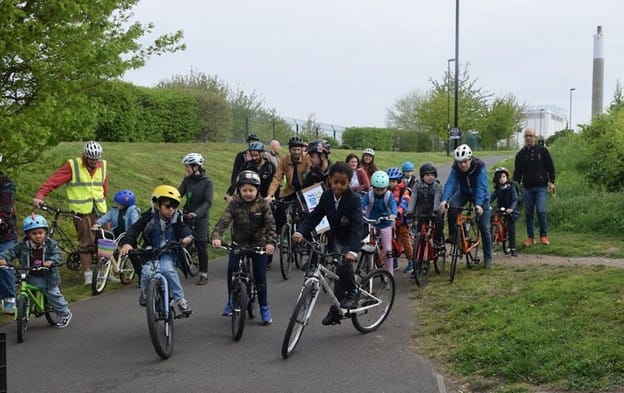
High excitement as the bike bus began at Bridgehouse Meadows and dropped off at Hatcham and Kender primary schools, before arriving at Edmund Waller school to a round of applause.
Across Lewisham, school streets have doubled in the last five years. Besides tackling congestion and improving air quality, a key aim of the school streets is making it easier and safer to walk, scoot or cycle to school.
Parents and caregivers are rising to the opportunity school streets offer, launching bike buses, changing their routines to walk, and in some cases, cycling cargo bikes.
Campaign group Solve the School Run found that an average 443 children a year are injured by vehicles during the hours of the school run in London.
One solution is a bike bus, with safety in numbers. A local group of parents and caregivers are launching a new bike bus route to serve pupils at three primary schools - Haberdashers' Hatcham, Kender and Edmund Waller primary schools.
One of the organisers, Mary King, said, “My kids are 10 and 7 and are looking forward to cycling with their friends.”
The inaugural ride was April 17th, and I doffed my helmet and joined in.
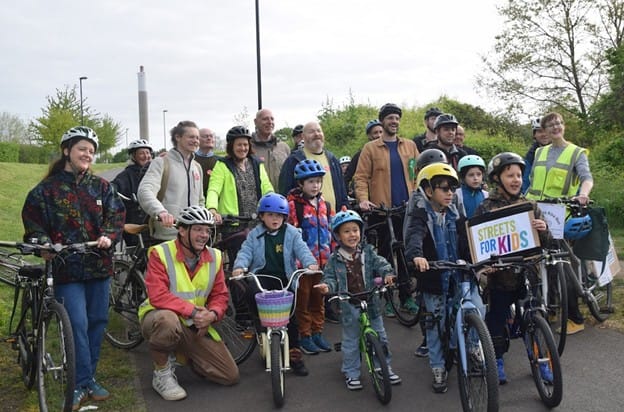
The bike bus
A bike bus is a group of kids, most often with some parents or carers, cycling to school together.
The group has put together two routes for alternating Fridays - on 17 April they started from Bridgehouse Meadows, and on 24 April they intend to cycle from Fordham Park, utilising the recently pedestrianised Cold Blow Lane.
Mary King was inspired to help organise the bike bus for a multitude of reasons, noting: “Bike buses are incredible grassroots initiatives with multiple co-benefits - encouraging people to cycle and to feel confident cycling on the roads, increasing the visibility of cycling, encouraging children's independence, encouraging activity and fitness, building community, having fun and fighting climate change through reducing vehicle emissions!”
The group gathered in Bridgehouse Meadows was buzzing with the expected amount of energy a dozen kids under ten can bring. There were also a handful of candidates from the Labour and Green parties, all on their bikes.
Commuters used to gliding through the meadow were blocked by the big group photo, but took it with good humour and wound their way around the crowd.
The kids had a special treat, getting to cycle with deputy headteachers, Dan Absolom from Edmund Waller Primary School and and Robert Vinnicombe from Kender Primary School.
Telegraph Hill parent Carrie Behar noted the importance of role models: “Children look up to their teachers so I think work to engage teaching and other school staff in active travel would also be useful.
"I am surprised at how many staff members drive to school and would love to see more support for adults from the school community to cycle, as well as provision of showers, lockers and all the other things which make cycling to work convenient and pleasant.”
James, father of 5 year-old Olive, said they’d been practicing for the bike bus. Normally, they cycle on pavements together, but he thought this was a nice opportunity for both kids and parents to gain more confidence cycling on roads in a safe way.
The mother of a boy in a dinosaur helmet noted that she didn’t normally cycle with her child to school, with his father usually walking alongside while their 8 year-old pedals. But for the bus, she’d come out, and everyone was on their bikes together.
After the group photo, the bike bus started off. Older kids rode side by side, chatting to friends with their school books in front baskets, while parents stuck closer to the smallest riders. Adults took turns marshalling, ensuring that they shielded the bus while kids were turning or crossing through a junction.
Schoolmates called out from their scooters, other pupils stood and waved at the kids whizzing past while they walked to school.
Sign-up for our free weekly newsletter - Salamander News in your inbox
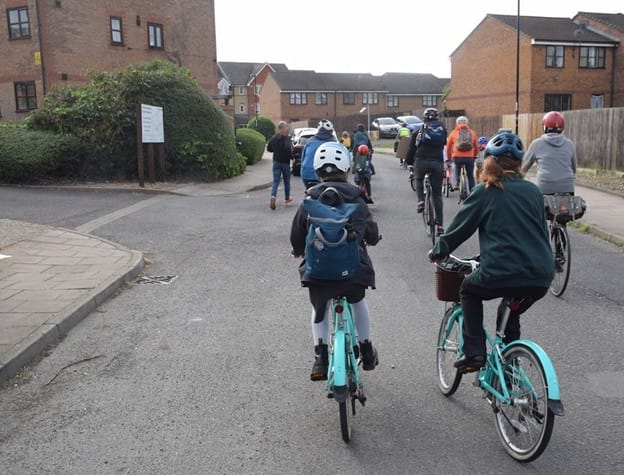
The route mostly stuck to quieter residential roads, with one short stretch of cycle lanes along Queen’s Road, and a pedestrianised alley on the side of Eckington Gardens.
Busy New Cross Road and Queen’s Road had to be crossed, and the groups waited at pedestrian crossings for lights to change in order to make it safely across. Jane Davis from Lewisham Cyclists had supported in testing different routes with King before the day, and also did a Dr Bike session at the end of the previous term at one of the schools which helped publicise the bike bus.
From school street to play street
One of the three primary schools on the route is Kender Primary School. Here Faulkner Street was a timed school street, then upgraded to being enforced with bollards in 2025.
The restrictions have proven so successful, that the road is leveling up and becoming a "play street", with a colourful surface including hopscotch and other games drawn in, to be unveiled before the International Day of Play in June.
Keith Barr is headteacher at Kender Primary School, and spoke to how transformational the Faulkner school street has been. Previously, the school had three different entrances, which could be narrow and unwelcoming.
Now, with a much larger gate and one big entrance, “Our new school gates have been truly transformational—the sense of bringing the community together as one is no longer an aspiration, but an everyday lived experience. They have been such a success.”
The change in surfacing has also had a positive environmental impact, with Barr noting there are more places for rainwater to go, reducing the chances of flooding.
Support independent community news from £2 per month or leave a tip.
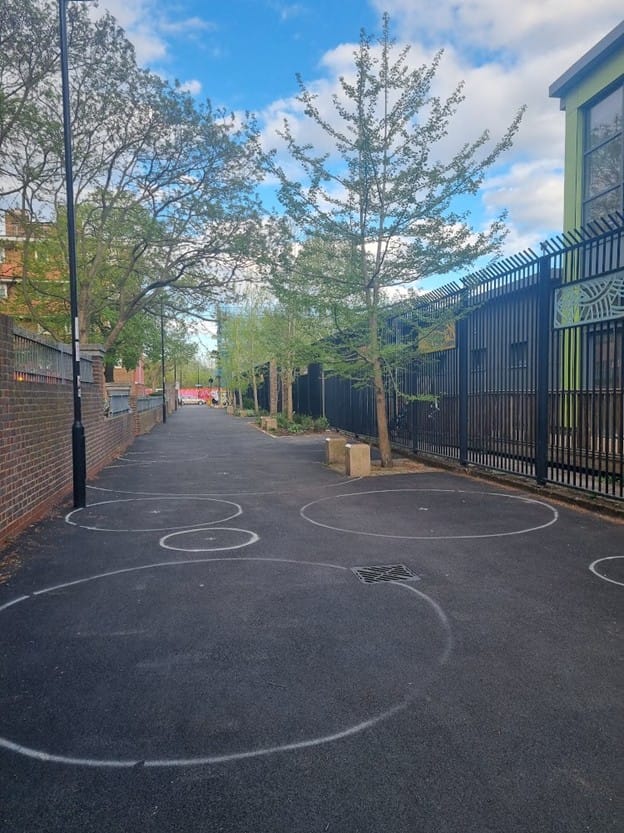
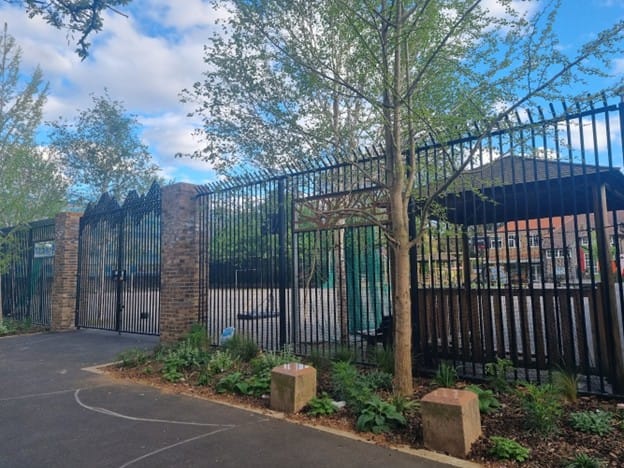
Faulkner Street is becoming a play street, also new big gate, planting to absorb rainwater and granite stools for anyone needing a rest. Image: Tomilyn Rupert
With the prospective nearby development at Besson Street, even more neighbourhood residents may be able to enjoy the newly car free space. For now, Barr is working closely with the local authority to plan a big day of play to mark the unveiling, but the kids aren’t waiting for a ribbon cutting and are already enjoying their space.
As Barr said, “The sense of joy and sheer fun is wonderful to see every day—so many children embracing the chance to cycle and scoot to and from school.”
Cargo bikes, scooting, and walking
Though the bike bus for these three schools is now every Friday, many families had already been taking advantage of the school streets programme.
At Kender, headteacher Barr said, the street has also made a difference to how children arrive and depart from school, “Scooters have increased, bikes have increased. When children come out of school in the afternoon, they cycle and scoot along the whole street.”
Carrie Behar is a parent with one child in nursery, and one who attends Haberdashers Hatcham Free School, located at the peak of Telegraph Hill. The school street on Pepys Road is open for two hours and fifteen minutes a day, and is camera enforced. Their school run modality? Walking.
Frequently passing another nearby primary school, John Stainer, she notices the differences between having a school street and not. “At Habs, the school gates are generally clear of vehicles during this time.
"There are some people who do still drive and park around the corner beyond the boundary of the school street, but it is a fraction of the congestion that I observe at John Stainer where there are cars parked all over the zig zag and double yellow lines, with beeping and shouting and general chaos.”
The Haberdashers school street operates limited hours, meaning pupils attending breakfast or after-school club don’t experience the same clean air and safety benefits as those whose families don't need the long hours.
In addition to more hours, Behar would also like to see the street boundary extended “to minimise the number of people who drive and park around the corner just on the perimeter, from which the walk up to the school is less than 1 minute.”
A committed car-free family, when it comes time to see the GP, or visit the library or swimming pool, the family opts for a cargo bike. Behar described herself as previously a novice cyclist, and notes that, “the lack of segregated cycle lines in Lewisham is a daily challenge.”
Without space to store the cargo bike in their home, they use a bike parking space, but point out that it is much further from their front door than neighbours with cars who can simply park kerbside.
This extends to school as well, with Behar saying, “At our school, the gates are too narrow to walk our cargo bike through the gate, and there is no secure parking outside the gates. There is limited space for children (or staff) to park bikes during the day, leading to a messy pile of bikes which is less than ideal.”
Lewisham leads on school streets .. but lags behind on active travel
Lewisham leads all other London boroughs in school streets, having the highest proportion with 56.7 %. according to Healthy Streets Scorecard. That’s twice as many as the Greater London Average in 2025, and over five times as many as neighbouring Greenwich.
But looking across all Healthy Streets measures, including road accidents and protected cycle lanes, Lewisham came last among inner London boroughs.
Lewisham's performance on the London schools’ Travel for Live programme, which aims to encourage active travel to and from school, was recently described by councillor Sian Eiles as “shockingly poor".
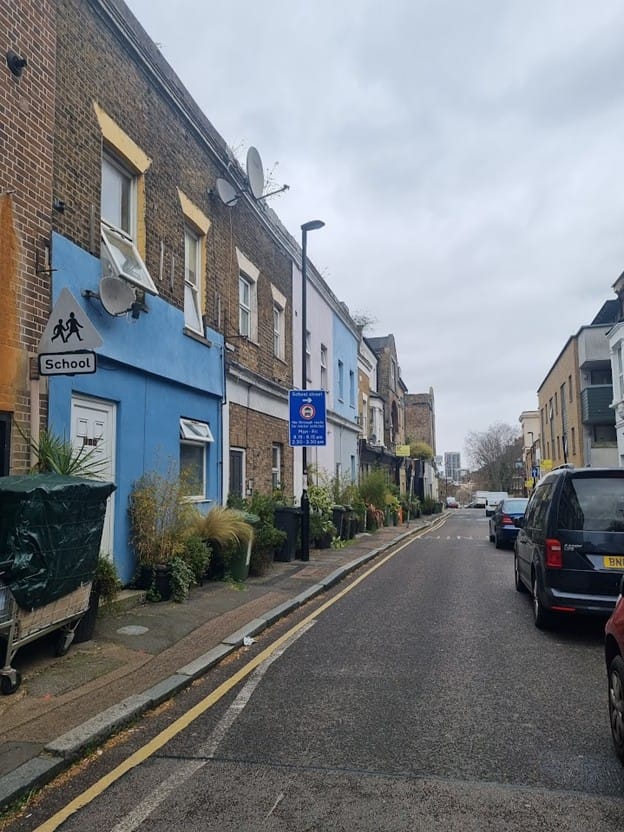
A school street is a road that has restrictions for motorised vehicles, at least during school pick-up and drop-off times.
Some roads, like the section of Scawen Road outside Twin Oaks Primary School, are blocked off to motorised traffic at all times and enforced with physical barriers like planters and bollards.
Others, like part of Blackheath Vale outside All Saints are blocked to motorised traffic for less than two hours a day, during school days only and enforced through CCTV.
Claire McDonald, of Solve the School Run, said, “The main issue we hear from Lewisham parents is that the school streets aren't substantial enough. For example, they may cover one school entrance but not the second, so the street closure just displaces the traffic.
"This would not happen if the school street was big enough in the first place. We think it should create a large zone of safety around the school, and these should be connected, enabling children to travel safely to their school street in the morning and afternoon."
Once the final stop of the bike bus reached Edmund Waller Primary School, the arrival of the bus was greeted with applause by staff and other adults, and I started cycling up Telegraph Hill away from the joyful crowd. Within five metres I was stopped, waiting for a driver reversing into a parking space who wasn’t making eye contact.
On the other side of the school, parents have launched a petition to seek school street status for Walsham Road, a cul-de-sac. The school newsletter said that the road, “serves some of the youngest and most vulnerable children in our community - with entrances for Nursery and The Cove (our Autism Resource Base).
Due to the nature of the road, parents in cars have to do a complete turn or reverse out of the road and we have already had a couple of near misses.”
Support independent community news from £2 per month or leave a tip.