'Net-zero industry is in decline': what does it mean for Lewisham's climate action plans?
The sustainable development committee was told that the shortage of retrofit, heat pump and solar installers is a key barrier to its plans. Tauseef Anwar explains why installers are abandoning the sector.

Lewisham council sustainable development committee scrutinised the council's climate action update on 9 September.
Martin O'Brien, head of climate resilience, outlined the plan and the council's achievements, particularly its high ranking in the climate score cards.
Dr Giovanna Speciale, co-founder and CEO of South East London Community Energy (Selce) was invited to present the co-op's work.
She emphasised that the organisation's work in renewable energy and retrofit is underpinned by its ongoing energy advice work, across many languages.
Speciale pointed out that the "biggest overall win" in terms of reducing emissions comes from energy efficiency actions, not renewables.
But when councillors asked the barriers Selce faced, she went straight to supply chain and return of value to the local economy.
"We don't have enough people with those retrofit skills," she said. "People have gone bust after government schemes have been withdrawn.
"We don't have many companies installing heat pumps."
O'Brien agreed. When councillors asked what challenges the council faces in reducing emissions he mentioned capital funding, capacity and the limits of council control, and continued "the shortage of tech skills to deliver .. Tech capacity is a challenge."
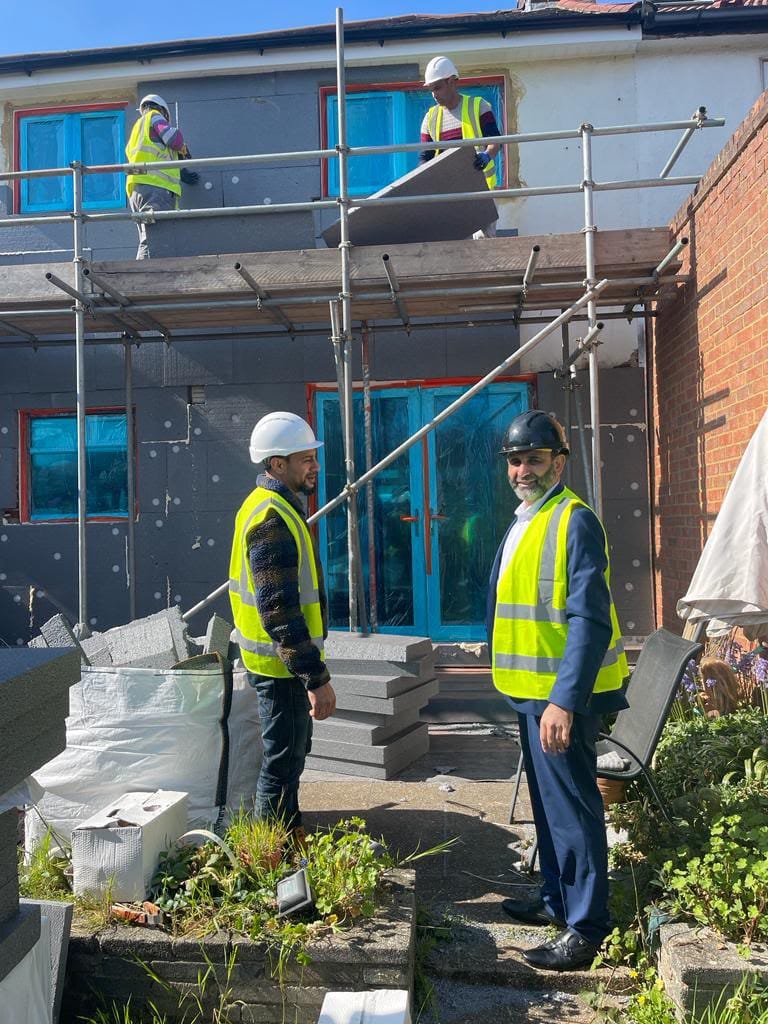
'Net zero industry is in decline'
Salamander asked Tauseef Anwar, founder of Association of Net Zero Installers (ANZI) to explain the reasons for the green jobs crisis.
Anwar was previously a Lewisham Labour councillor, who introduced the motion which led to the council declaring a Climate Emergency in 2019 and represented the borough at COP26 in Glasgow in 2021.
He left Labour in March 2026 and sat as a Green councillor, before stepping down at the May elections.
“Since 2024, the net zero industry has been in decline, especially since the government announced last year that ECO4 would close without transitional arrangements or a similar successor scheme," Anwar said.
"The small business side of the industry has collapsed. One survey alone showed that 19,423 retrofit professionals have been made redundant and 209 businesses have gone into administration."
He noted the human impact of the end of the scheme, affecting millions of vulnerable people, including nearly 10 million who are living in fuel poverty.
"The Warm Homes schemes have begun, on a tiny scale compared with the scale of the announcement, but they have yet to replace ECO, which began delivering support in 2013, at anything like the same scale.
"I know many vulnerable people in Lewisham who desperately need help to replace an old boiler, for example, but cannot access funding."
He argued that new schemes are being focused to deliver through local authorities, but small businesses will struggle to get work.
"Local authorities are not doing enough to bring those benefits to local small businesses," he says. "The bar for joining a council procurement framework is too high."
He agreed with Speciale on the importance of energy efficiency.
“I am concerned that insulation is being deprioritised in favour of renewables in upcoming schemes. It is hardly fair to install renewables in cold homes without adequate insulation.
"This is a direct result of lobbying, backed by some utility companies.
“The government announced last year that it would create 400,000 new green jobs, but so far we have seen redundancies in the sector, and skilled professionals are moving into other professions because of the constant instability. "
Salamander has reported on the delayed in government grants for air-to-air heat pumps, which were announced in November 2025.
There is still no MCS "certification pathway" meaning installers are still not able to sign-up for the scheme, and no-one can claim the grant.
There are rumours that the Boiler Upgrade Scheme, which offers grants for air-source air to water heat pumps may be scrapped in the next budget, which would deal another blow to the industry.
Tauseef said: "I have met many business owners who narrowly avoided bankruptcy but are now investing in other sectors and leaving this one for good.”
Impact of high price of electricity
Speciale told the committee that the UK's high price of electricity (which is driven by the price of gas) was another a barrier to decarbonisation.
"In community buildings, it doesn't always make sense to decarbonise, because of the price of electricity compared with gas," she said.
O'Brien echoed the point: "The costs and benefits of investment in housing are not well aligned.
"The issue of scaling up decarbonisation is a huge challenge for us," he said.
The council announced on 1 October that it has chosen a local enterprise Ksquared "to make hundreds of council homes warmer and greener".
Have they solved the jobs crisis? Unfortunately not.
Ksquared will co-ordinate the retrofit programme and support residents but the challenge of sourcing installers remains.
District heat networks and 'dirty heat'
Beckie Sanders, councillor for Telegraph Hill noted that domestic heating is biggest source of emissions in Lewisham and asked: "Is a heat decarbonisation strategy part of the new plan?"
O'Brien confirmed that heating from domestic properties is biggest source of emissions for the borough, and Lewisham's biggest decarbonisation challenge.
He confirmed that the council is working on a local area energy plan with colleagues from Lambeth, Southwark and Greenwich, and hoped to have a strategy for decarbonisation but the end of the year.
The council plans to decentralise heating, extending its plans for district heat networks.
This raised alarm bells for Salamander. The four councils shared commissioning of South East London Combined Heat and Power (SELCHP) incinerator in 1988, which they chose to site in a highly deprived part of Deptford.
The council's climate emergency plans included SELCHP as a "partner" from the start and have never questioned the sourcing of district heating from incineration of household waste.
The council has consistently failed to challenge the incinerator's "green energy" and "low-carbon heat" claims or to acknowledge air pollution harms from incineration.
Salamander has calculated that over 100 waste trucks are making journeys from Greater London and across England through Deptford every weekday, to feed the incinerator.
Planning for extreme heat
Kate Anderson, chair and councillor for Telegraph Hill, asked about "resilience and adaptation given the summer we've just had .."
O'Brien said: "The corporate resilience team led the wash-up of impact on council services ..
"But there are challenges in terms of buildings, schools and targeting those residents who are most vulnerable to extreme heat."
There was widespread criticism of the council's weak response to the summer's back to back heatwaves, which barely featured in its stream of social media comms.
The advice seemed to come from another era of British weather, failing to grasp the severity of the issue, the risks to life for vulnerable groups and the links with poor housing and inequality.
Schools across Lewisham closed haphazardly and it seems without guidance. Some parents resorting to crowdfunding fans while there were reports of young children in distress and children fainting in classrooms.
O'Brien said that the council's task and finish group is preparing for next year, and it recognised the need to communicate to all residents as well as build on the mayor of London's Heat Ready London plan, issued in June 2206.
Gavin Moore, councillor for Bellingham, said that this had come up at the Audit and Risk committee on 8 September, which reviewed what has been learnt from the London-wide operation Helios and this summer.
Following the July heatwave of 2022, Operation Helios was initiated as a test of London's emergency services' response to extreme heat.
The committee made closing recommendations including smart targets, greater emphasis on adaptation and resilience and a search for "external or innovative routes to investment or delivery".
It confirmed heat decarbonisation as a "huge strategic priority".
Support local independent journalism from just £2 per month or leave a tip.