The heat pump that can cool London's homes
After a summer of back-to-back heatwaves, demand for cooling is rising. Are reversible air-to-air heat pumps the answer?
"The technology is actually pretty simple. A heat pump takes heat from one place and moves it to another place.
"So when it takes heat from one place, it makes it cooler. And then when it moves that heat to the other place, it makes it warmer ..
"And heat pumps are reversible, so that the unit that's indoors can make the indoor space cooler and the outdoor space warmer, or vice versa."
Salamander spoke with Charlie Richmond, a Canadian sound engineer and heat pump expert, who spends part of each year in London.
Richmond has recommended and monitored many air-to-air heat pump installations from start through to operation, follows the industry closely and is passionate about spreading the word.
"If I had to do it all over again, I wouldn't be a sound engineer, I'd be in renewable energy," he says.
Air-to-air heat pumps have been in use for decades across the rest of Europe, in North America and around the world, and have been quietly adopted in the UK's commercial sector.
But they are only now beginning to breakthrough as a solution for heating and cooling UK homes.
They are cheaper and easier to install than the air-to-water heat pumps that are now becoming familiar as the green and energy-efficient alternative to gas boilers.
Air-to-air heat pumps bypass the UK's traditional radiators. Most crucially, they can be switched to cooling.
Climate change, caused by still rising fossil fuel emissions, is driving the brutal heatwaves we've experienced this summer.
And across the UK, London's homes are the most vulnerable to over-heating.
How do air-to-air heat pumps work?
Richmond explains that heat pumps are using refrigerants, following the same principles and simple physics of energy exchange used in a fridge.
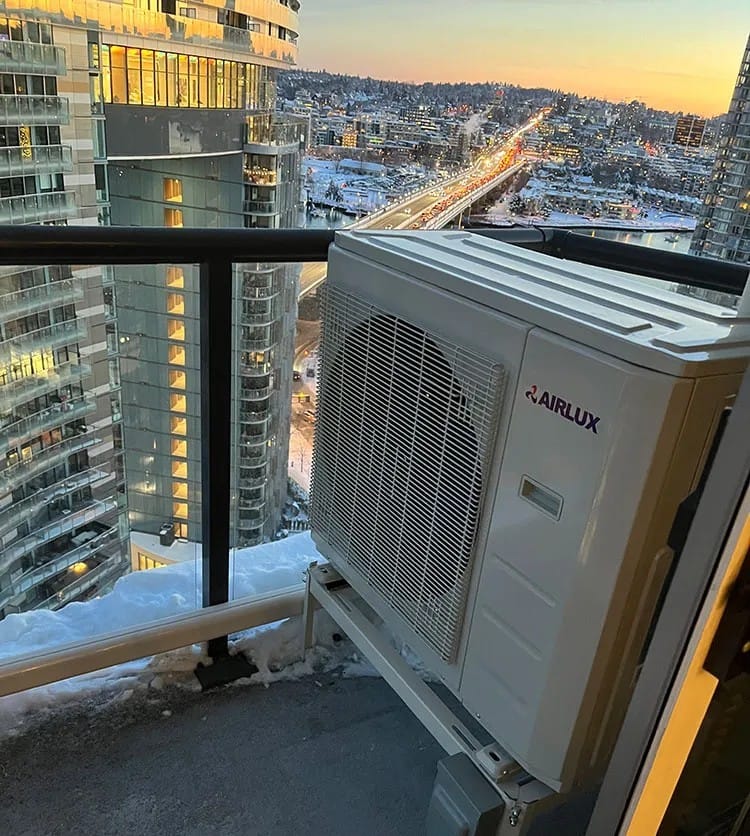
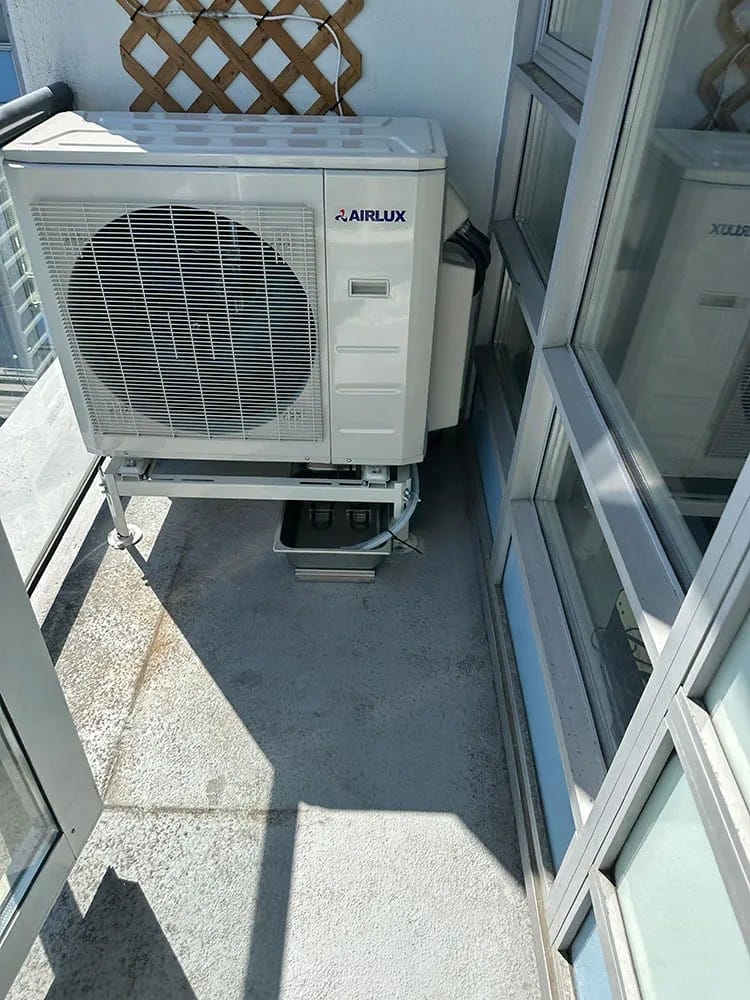
He explains that the optimum set-up is a "mini-split", where the compressor for the refrigerant is outdoors, while the heating/cooling units are placed high in each room.
"The compressor is quite a large unit that sits outdoors and has a large radiator and a large fan and is very efficient at passing air through it, so that it's very quiet and very efficient."
However, if outdoor installation is not possible, the entire unit can be installed indoors, although this set-up is less efficient.
Sign-up for our free weekly newsletter - Salamander News in your inbox
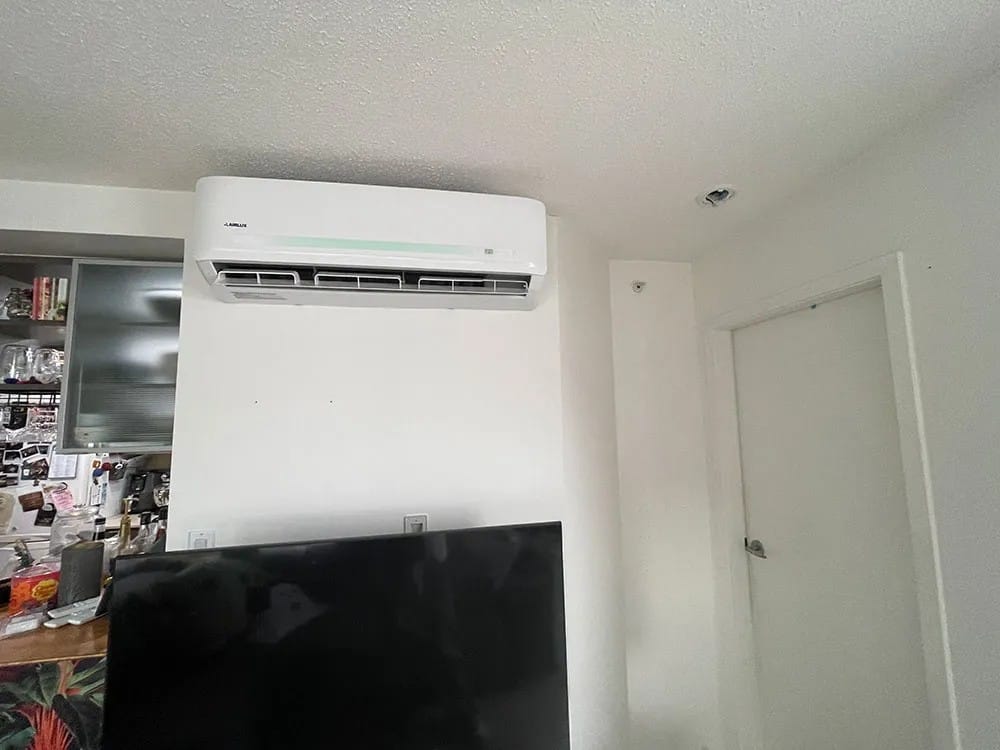
Outdoor heat pump on a balcony, and an indoor unit in an apartment. Images: airlux.ca
How many indoor units do you need?
A single outdoor unit can run many indoor units. But Richmond tells me that so long as you keep indoor doors open, a single unit can heat or cool several rooms.
"In our flat here in Vancouver, we have five rooms, essentially, and one heat pump [indoor unit]. And it does a very good job of keeping the entire flat at a good temperature.
"But of course, the front room where it's mounted is the one that cools or heats first."
Richmond shows me how, using a remote control, he can switch modes from heating to cooling, with other options for dehumidifying or a simple room fan.
There will be government grants .. but not yet
The Department of Energy Security and Net Zero (DESNZ) proudly announced "discounts for families to keep warm in winter and cool in summer" in November 2025.
(It later clarifies that discounts are available to "all households".)
It describes new grants for air-to-air heat pumps that can heat and cool, stating that: "The typical cost of installing an air-to-air heat pump in a flat or small house is around £4,500," while the grant will offer £2,500.
But the press release was premature. Nine months later, the grant appears on the government site Boiler Upgrade Scheme, but you still cannot actually claim it.
MCS certification still "in progress"
In order to claim the grant, you need to use an MCS certified installer. But a request for MCS certified installers brings the response:
![text from message on MCS website: Air-to-Air heat pumps. There are currently no installers certified for this technology .. [this technology] will be available to installers later this year.](https://www.salamandernews.org/content/images/2026/08/image.png)
The MCS did not respond to our request for comment.
Salamander tried to contact Polly Billington MP, the new minister for Energy Consumers at DESNZ.
She was previously founder and CEO of UK100, the network of local leaders pledging a rapid transition to net zero, so we expected her to be excited by the government's offer.
However, a DESNZ spokesperson responded, promoting the benefits of the scheme once again, but adding: "The Government is actively supporting MCS to establish a certification pathway for installers, with significant progress being made."
The MCS update warns of "several steps remaining in the process". DESNZ did not respond to a question on how long those remaining steps would take.
What's the red tape, will my home qualify for the grant?
However, Charlotte Lee, chief executive of the Heat Pump Association spoke with Salamander to explain some of the red tape around the grant scheme.
She confirmed that it is a regulatory requirement that the product and the installer are MCS certified.
She explained that in order to qualify for the grant:
- 100% of the heating load must be provided by the new heat pump, ie you can't keep your old boiler for backup.
- Your hot water may be provided by the air-to-air heat pump (if it has the feature) or an immersion heater (if not), you can't keep your old boiler for this either.
- You must have an indoor unit for every habitable room (ie every room, excluding kitchen and bathroom).
- You can have up to 5 indoor units.
If you are interested in getting an air-to-air heat pump, but not expecting to meet all these requirements, then you may want to go ahead and get some quotes.
Given the demand for a unit in every room to qualify for the grant, you may find that going with fewer units is an acceptable solution in terms of heating or cooling, and cheaper.
Richmond suggests that installers who are MCS certified for installing air-to-water heat pumps, will almost certainly have the skills to install air-to-air technology.
Support local independent journalism from just £2 per month or leave a tip.
What about hot water?
Most air-to-air heat pumps don't heat hot water, although a small minority of models have a different design to handle this.
If you're planning to replace a gas boiler with an air-to-air heat pump (and you will need to remove your boiler if you wish to qualify for the grant), Richmond recommends a small electric hot water tank is the simplest solution.
"Direct electric hot water heating is quite efficient. Not quite as cheap to operate as with an (air-to-water) heat pump .." Richmond points out, but this air-to-water would be an expensive solution for hot-water only.
How green is it?
The heating function of an air-to-air heat pump will bring a big reduction in household carbon emissions, compared with using gas, oil or biofuels for heating.
It will even be a little more efficient than the UK's more common air-to-water heat pumps, used for heating radiators or underfloor heating.
"The heat pumps that heat hot water are less efficient than air-to-air heat pumps," Richmond says, "purely because they have to raise the temperature of the water much higher than it needs to raise the temperature of the air."
But the cooling function operates the same way as any other air conditioning units. It can't use "renewable" heat from the air, and is solely driven by electricity, although some models will be more efficient than others.
How green the cooling is will depend on your electricity mix - if you use clean, renewable electricity or have solar panels, then it will be close to zero carbon.
How well do heat pumps work throughout the UK winter?
"The heating process of an air to air heat pump is very efficient especially in a moderate climate like London's," Richmond says. "Even when the outside temperature stays just above freezing there is still lots of heat available in the air.
"It becomes less efficient the further it drops below freezing."
He adds that within the last five years, the technology has scaled and improved further. Heat pumps used to be efficient down to -15 C, but now they're efficient down to -30C.
Heat pumps can work well in much colder climates than the UK's, and are used across Canada, performing well in cities much colder than Vancouver.
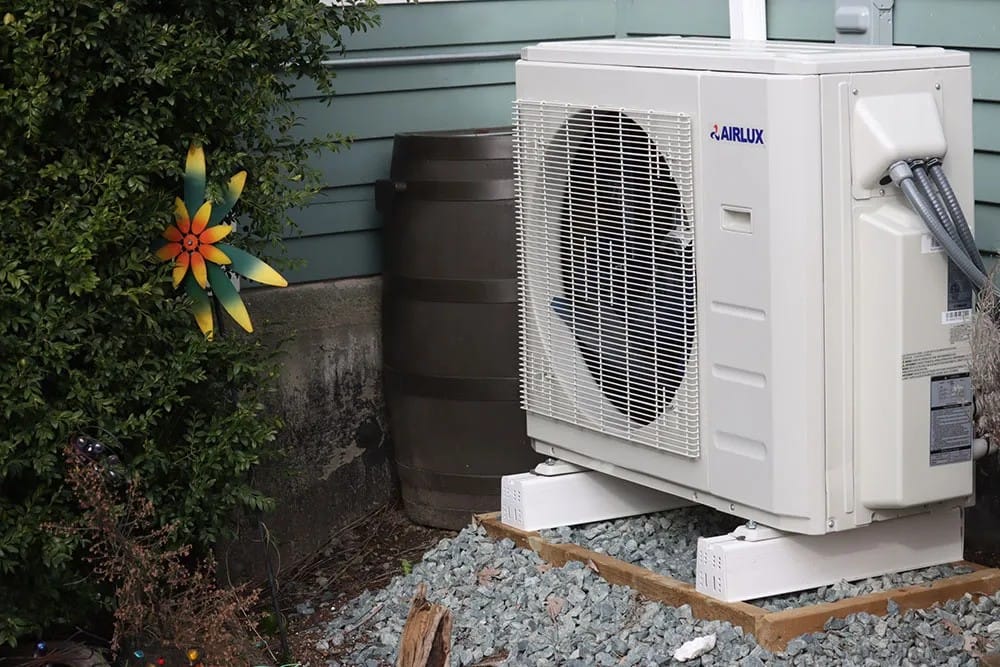
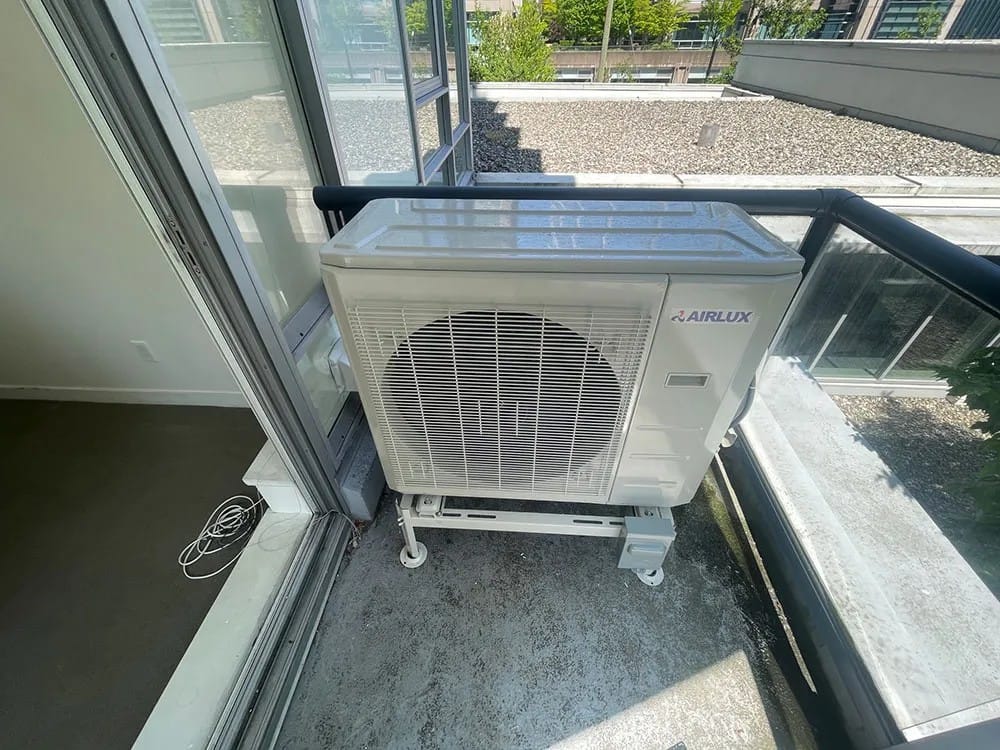
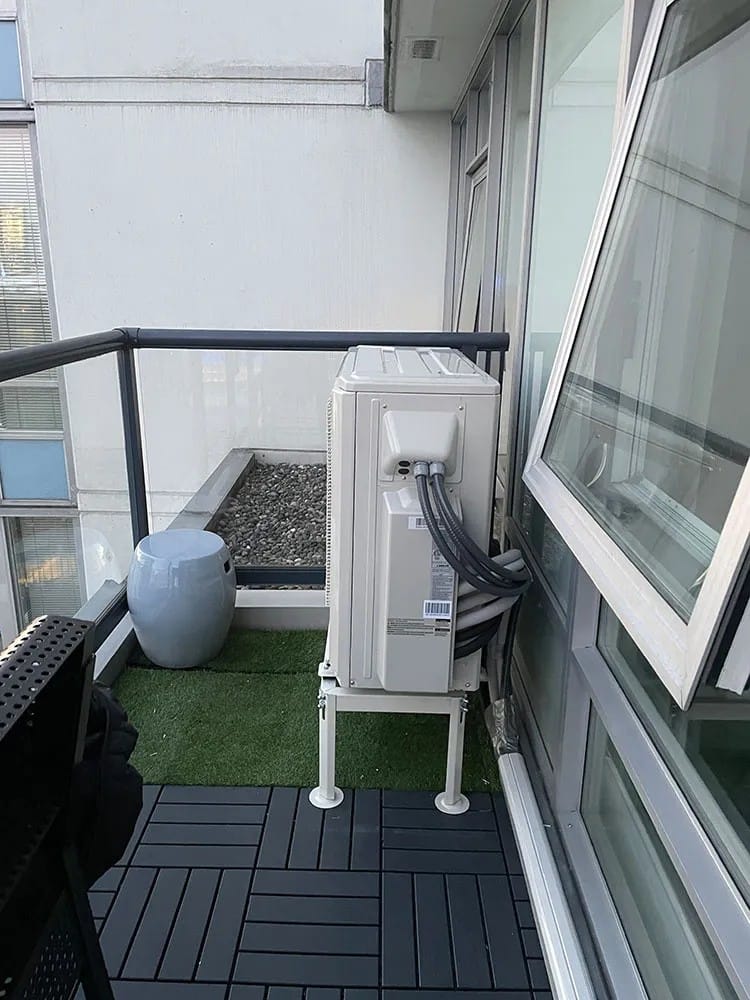
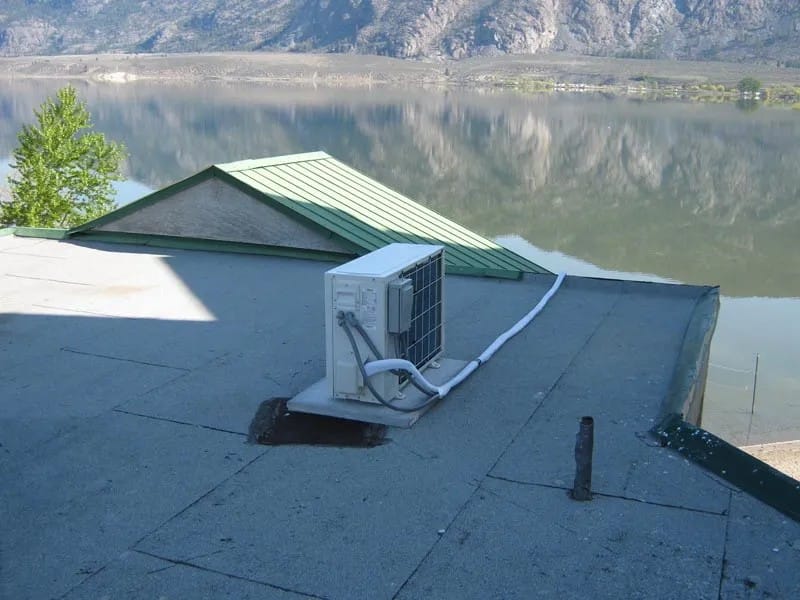
Outdoor heat pumps. Images: airlux.ca