Healthy Streets 2026: Lewisham scores lowest across inner-London for 3rd year in a row
Despite its lead on School Streets, Lewisham's poor scores on controlled parking, protected cycling and traffic reduction kept it at the bottom of the league for inner London boroughs.
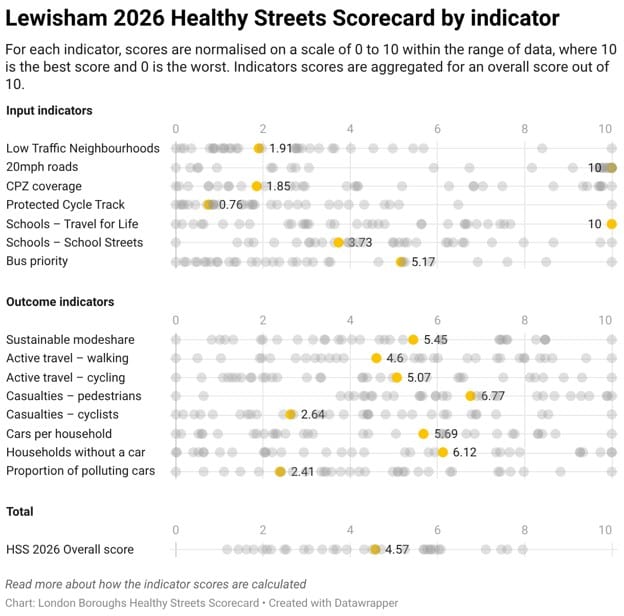
The 2026 Healthy Streets Scorecards are out, and Lewisham residents may be dismayed to see that the borough has remained last among inner London boroughs, a position it also held in 2024 and 2025 (in 2023 it scored .04 points above Kensington and Chelsea).
The overall score for the borough did rise, from 4.41 to 4.57, out of a possible ten points.
The annual scorecard measures London streets on a variety of indicators, from share of school streets to protected cycle lanes. 2026 marks its 8th publication and this year data has expanded to include TfL owned A-roads, which carry 30% of the capital’s traffic.
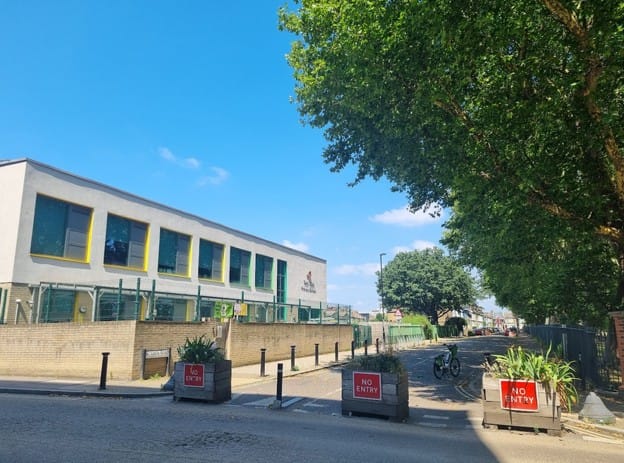
Lewisham remains the leader in school streets, with new schemes added over last year bringing coverage to two-thirds of schools. It remains the highest scoring borough in London on the measure.
The school streets programme closes streets to motorised traffic, sometimes for several hours and school pick-up and drop-off times, and other closures have been made permanent. It’s designed to encourage active travel and reduce injuries and deaths.
Neighbouring Southwark was ranked 4th overall, with a score of 6.09. Greenwich scored just 3.37, the same that it had the year before.
Space for cycles
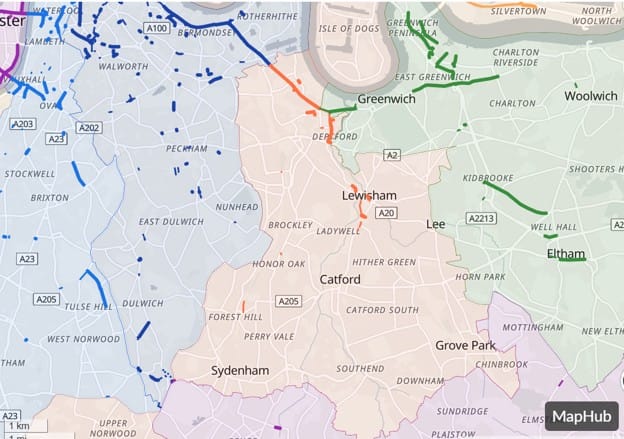
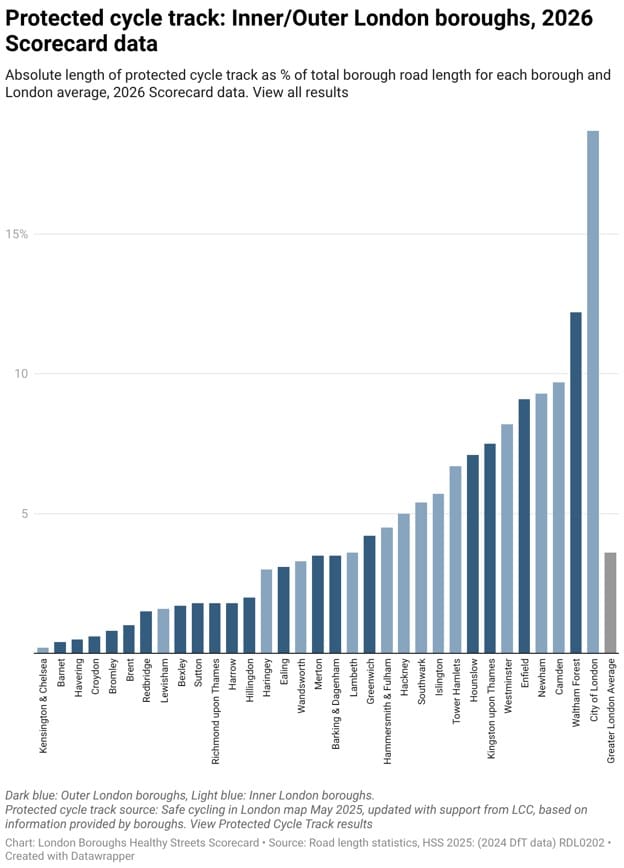
Just 1.6% of roads in Lewisham have protected cycle tracks, only 38% of the amount that neighbouring Greenwich has. This represents an increase from the 1.5% in Lewisham over the prior three years.
Although the past year saw the opening of Deptford Church Street cycle lane, it also saw the long temporary closure of key cycle routes such as Waterlink Way, and misleading press releases trumpeting an increase in cycle lanes but without additional infrastructure.
Another Healthy Street Scorecard indicator is sustainable modeshare, which measures the proportion of trips taken in the borough by modes other than driving.
This fell by a single percentage point, to 72%, with only Newham doing worse on this measure across inner London boroughs. However, the Healthy Streets group cautions that the sample size is small, so the percentage drop is hard to read as a trend.
Only 3% of trips in the borough took place by cycle. By contrast, the group estimates that an additional two percentage points of adults cycle weekly in Lewisham, up to 15.9% from 13.3% the year before.
Space for cars
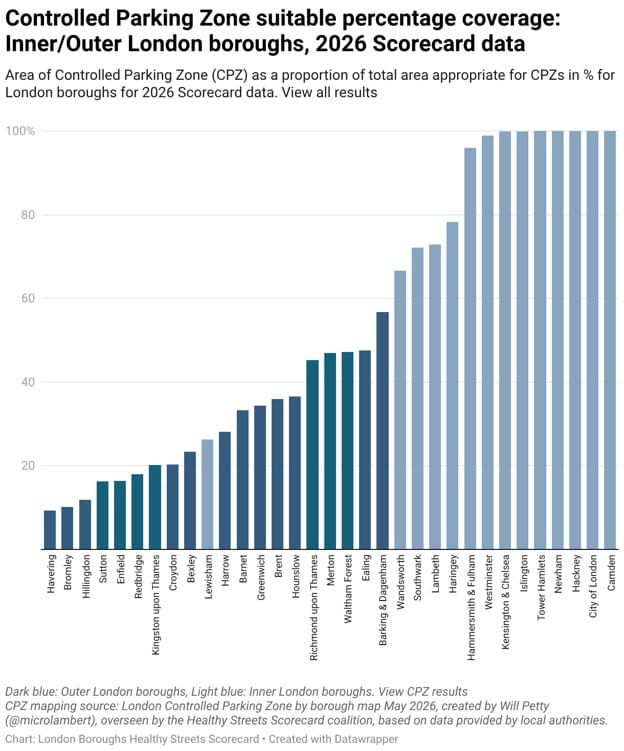
One of Lewisham’s lowest scores is for lack of controlled parking zones (CPZ).
Attempts to expand the CPZ, along with the Sustainable Streets programme, have been controversial in the borough. While some areas were upset at being left out, others, such as Telegraph Hill, successfully organised motorist-led campaigns against proposed introduction.
Nine outer London boroughs, generally considered more car-dependent, score higher than Lewisham on this metric.
CPZs are used as a Healthy Streets indicator as their introduction is meant to reduce traffic and congestion, by managing demand and reducing incentives for people to drive to the borough. Six boroughs have 100% coverage of CPZ.
Car ownership has remained consistent across Lewisham, hovering at 54.5 per 100 households, a slight increase, though conversely the total number of registered cars has experienced a slight decrease.
Lewisham has the highest car ownership rate of inner London boroughs.
It has 17.6 more cars per hundred households more than neighbouring Southwark, though slightly fewer than Greenwich, which has 60 cars per hundred households.
Casualties
One of the outcome indicators measured by the scorecard is casualties, both serious and fatal, compared to number of journeys undertaken by walking and cycling. The group notes that, “London remains behind its Vision Zero target, but 2025 road fatalities are estimated at 95, the joint-lowest figure outside the pandemic year.”
Data is drawn from several years prior, meaning that the tragic deaths in Lewisham so far this year, of experienced cyclist Irene on New Cross Road, and a young pedestrian on Sanford Road, have not yet been reflected in the data.
Lewisham scored in the middle of inner-London boroughs on this indicator, with an average of 5.58 casualties per 100,000 walking stages, .15 higher than the inner-London average.
For cycling casualties, Lewisham sits in the bottom third of inner-London boroughs, with an average of 2.24, which is .37 higher than the inner-London average.
Support local independent journalism from just £2 per month.