ULEZ brought 40% reduction in air pollution deaths but 'job isn't over'
New report shows London's ULEZ saving thousands of lives every year, but toxic air from sources such as traffic, aviation and gas heating is still causing chronic illness and premature deaths across the capital.
New research from Imperial College London found an estimated reduction of 41% in nitrogen dioxide (NO2) and 28% in particulate matter PM2.5 between 2019 and 2024.
Premature deaths across London due to air pollution dropped from between 6,390 to 8,040 in 2019, to between 3,800 to 5,100 in 2024.
The report suggests that the Ultra Low Emissions Zone (ULEZ) was the main policy responsible for the reduction in pollution levels from road transport in London, and resulted in the dramatic reduction in associated deaths.
The ULEZ brought 97% of vehicles up to a more stringent, lower emission standard for NO2 - the only air pollutant which has a limit recognised in UK law.
However, the report also found that the health impacts of the key pollutants are more serious than thought, resulting in adjusted calculations of deaths attributed to air pollution for 2019.
It found a stronger association between air pollution and premature death, and associations with heart disease, strokes, dementia, type 2 diabetes and asthma.
Legal limits not the same as safe levels
The report stresses that UK legal limits for air pollution are not the same as safe levels, health effects continue even at low concentrations and that there is new evidence that PM2.5 harms health at the lowest measurable levels.
Sadiq Khan said: “The evidence is now overwhelming and unarguable: the bold action we have taken in London has reduced pollution, improved public health and saved lives.
"From childhood asthma to dementia, we know that a wide range of illnesses are linked to air pollution. This latest data shows why expanding ULEZ London-wide was even more important than we previously thought and is transforming lives right across our capital."
Research also found a reduction in the number of hospital admissions in different areas following the introduction of the ULEZ. They saw 9.3% reductions in yearly figures for heart related emergency admissions and 5.1% drop in yearly figures across all illnesses.
All commentators celebrated the success, but there was widespread agreement that there is much more to do.
Dangerous ozone levels
Green Party assembly member Caroline Russell told the Local Democracy Reporting Service (LDRS): “Just as we knew it would, the London-wide ULEZ has delivered cleaner air across the capital, saving lives and improving the health of millions of Londoners. Its success is a testament to the many campaigners who pushed for the Mayor to act so that Londoners can trust the air they breathe.
“But this is not the end of the story. Too many Londoners are still breathing air that damages their lungs and increases the risk of serious disease.
“That is why we must go further, by rejecting the expansion of Heathrow, tackling dangerous pollutants such as ozone and most importantly by further reducing miles driven in London by investing in clean, safe and sustainable ways to travel around our city.”
Ella's Law and WHO guidelines
Izzy Romilly, Sustainable Transport Manager at Possible raised Ella's Law, the Clean Air (Human Rights) Bill which would bring World Health Organisation (WHO) guidelines into UK law.
UK target levels are much weaker that WHO guidelines, making the UK targets unsafe.
"These new findings go to show what's possible with leadership - ambitious action can change and save lives," Romilly said. "But our air is still toxic and the job isn't over.
“We need politicians of all parties and levels of government to work together and set out a vision for a UK where no one breathes toxic air, wherever they live or work.
“We know what needs to happen: we need a national Clean Air Act, ramped-up action on transport and diesel, quality housing with clean, cheap energy for all, and no more airport expansion.
"With vision and action we can continue working towards WHO guidelines and make sure no one is made sick by the air they breathe."
Where is the worst air pollution?
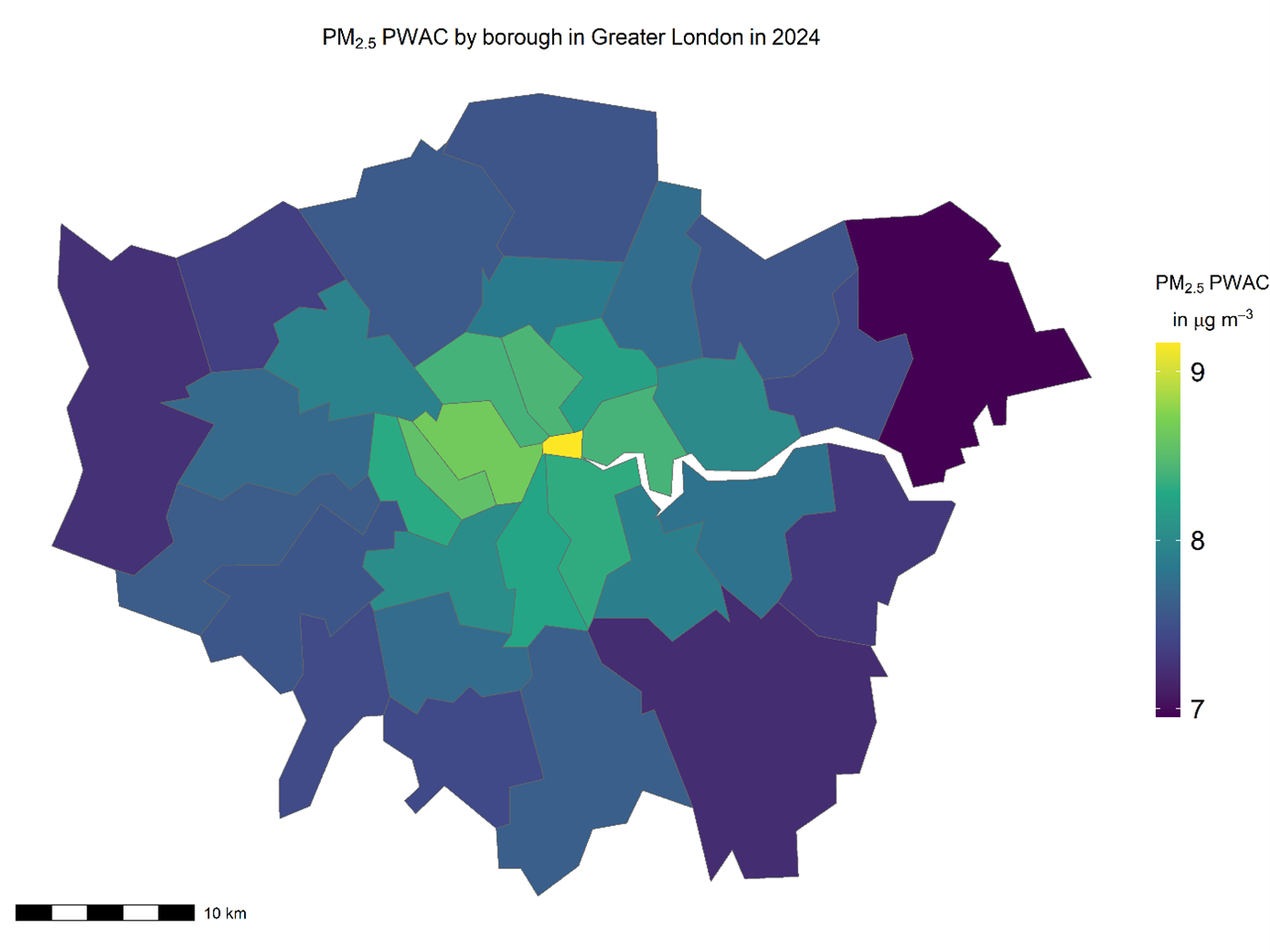
The highest concentrations of PM2.5 and NO2 were mainly found in central London and inner boroughs, although with raised levels in outer London boroughs around Heathrow Airport.
Lewisham came 14th in the ranking of 33 London boroughs with the highest PM2.5 air pollution, with an annual average level of PM2.5 of 7.90 μg m-3.
The World Health Organisation guideline level is 5.0 μg m-3, and research shows that even levels below that damage health.
On NO2, Lewisham came 17th in the ranking of highest levels of pollution, with an annual average of 16.77 μg m-3.
The World Health Organisation guideline is 10 μg m-3
But outer London boroughs of Bexley, Havering and Sutton have the highest number of deaths attributable to air pollution per 100,000 residents, despite having relatively lower pollution concentrations.
This is due to their older populations, which means the impact of extending ULEZ to outer boroughs, in terms of lives saved, was higher.
Main sources of air pollution
Although the primary source of NO2 and PM2.5 air pollution in London is still road traffic, the report also notes commercial cooking emissions, domestic wood burning and construction dust as key sources of PM2.5.
The research found raised levels of NO2 across the road network, but also coming from Heathrow Airport (including emissions from jets), gas plants and gas central heating, emissions from sewage treatment works and from Non-road Mobile Machinery (NRMM) used in construction.
Reporting of London assembly member comment from Kumail Jaffer, Local Democracy Reporter.
Support local independent journalism from just £2 per month.