Heat danger: climate crisis collides with World Cup
Scotland v Brazil on 24 June in Miami has a "near certain" chance of exceeding conditions which football union says affect performance and risk health.
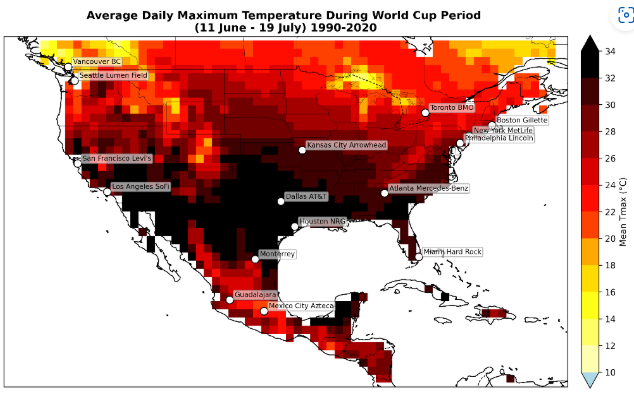
New analysis from World Weather Attribution (WWA) has found that around 25% of World Cup games are likely to be played in conditions of heat and humidity that affect performance and risk the health of players and fans.
The global football union FIFPRO advises that when the wet bulb globe temperature (WBGT) index exceeds 26°C, player performance is impacted and safety measures like air conditioning must be implemented.
Around 26 of the 104 matches are likely to be played in conditions that exceed 26°C WBGT.
Scotland v Brazil on 24 June in Miami is one of those matches, played in a stadium without air conditioning and where the chance of exceeding WBGT of 26°C is "near certain."
About five games are expected to take place at WBGT of 28°C, conditions that have an impact on the human body equivalent to about 38°C of dry heat.
FIFPRO considers WBGT of 28°C and above unsafe for players and warns that in these conditions, planned matches should be postponed.
Elliot Arthur-Worsop from Football for Future told Salamander: "Football is entering a new era where extreme heat is no longer a hypothetical future risk, but an increasingly real operational and player welfare challenge for the game.
"As the climate crisis accelerates, tournament organisers will face increasingly difficult questions around player safety, supporter wellbeing, scheduling, and the resilience of football infrastructure itself."
What is wet bulb globe temperature and why does it matter?
WBGT is an index of humidity and temperature that reflects how effectively the human body can cool itself.
Dr Chris Mullington, consultant anaesthetist at Imperial College NHS Trust and honory clinical senior lecturer at Imperial College London explains why higher humidity increases heat risks to health:
"A 30°C day in dry, breezy conditions is very different from a 30°C day with high humidity, strong sun and little wind.
"High humidity reduces the evaporation of sweat, limiting the body’s primary cooling mechanism ..
"When wet bulb globe temperature exceeds 26°C, player performance can suffer.
"Above 28°C, the risk of serious heat illness becomes more concerning — not only for players, but also for the hundreds of thousands of fans in stadiums and outdoor fan festivals.
"Heat stroke, the most severe form of heat illness, is life-threatening, and older people and those with pre-existing medical conditions are particularly vulnerable.”
Heat risk to supporters at fan festivals
Three out of 16 of the World Cup venues have cooling, but at many of the 13 stadiums without air conditioning, including Miami, Kansas City, New York and Philadelphia, there is a risk of exceeding 26°C WBGT.
But even at air conditioned stadiums, supporters at the organised "fan festivals" outside the arena will be at risk.
The Dallas and Houston stadiums in Texas are air conditioned, but their fans watching outside face a 1 in 3 chance of temperatures of 28°C WBGT and above for most of the World Cup matches.

The tournament's most prestigious stadium in New York is not air conditioned. Players and fans at the World Cup Final face a 1 in 8 chance of conditions exceeding 26°C WBGT.
Dr. Friederike Otto, Professor of Climate Science at Imperial College London said: “That the World Cup Final itself - one of the biggest sporting occasions on the planet - faces a non-insignificant risk of being played in 'cancellation-level' heat should be a wake-up call for FIFA and fans, highlighting the urgent need to realise that there is no aspect of society not affected by climate change.”
Half of human-caused climate change has happened since 1994
The scientists compared the conditions with the last North American World Cup held in 1994 and found that the number of games likely to be played at extreme temperatures has nearly doubled.
Dr Otto said: "The 1994 World Cup may not feel particularly distant to many adults today, yet half of human-induced climate change has happened since then.”
Dr. Joyce Kimutai, Research Associate in Extreme Weather and Climate Change at Imperial College London said: “The climate that the tournament is being played in today has fundamentally shifted in just 32 years ..
"There’s a very real risk that we’ll be faced with games taking place in conditions that are unsafe for players and fans."
Support local independent journalism from just £2 per month or leave a tip.
The most polluting World Cup in history
The World Cup has already been controversial on many fronts, which have combined to have chilling effect on visitor numbers.
ICE raids continue across the US and have swept visitors from all countries of the world into brutal detention centres.
FIFA have been widely criticised for extreme price-hiking and Trump and his administration have given mixed and changing messages on Iran taking part.
But the increase in the number of teams from 32 to 48 and the geographic spread of games across the continent means that scientists expect the 2026 tournament to be the most polluting World Cup ever held.
The number of matches has increased from 64 to 104 and teams, officials and fans will be flying between 11 geographically distant stadiums across Mexico, the US and Canada.
The New Weather Org expect the event to generate around 9m tonnes of greenhouse gas emissions, mainly from aviation and construction of stadiums.
In 2021, FIFA committed to cut its greenhouse gas emissions by 50% by 2030, but in practice, it has almost doubled them.
New Weather Org reports that 9m tonnes is their lower estimate and that recent research shows that the greenhouse gas impact of air travel has been routinely underestimated.
Using the new metric, emissions from the North American World Cup could be as high as 15m tonnes of CO2 equivalent.
They also point out that the Saudi-Aramco sponsorship of the World Cup finals is expected to induce emissions of around 30m tonnes CO2e, from increased sales for the company.
Arthur-Worsop said: "For UK players and fans, there can be a tendency to see extreme heat as someone else’s problem, but that’s changing fast.
"English football is already experiencing growing disruption from climate impacts, from flooded grassroots pitches to extreme weather affecting participation and scheduling.
"Major tournaments like the World Cup are simply bringing these risks into sharper global focus. The game needs to adapt quickly if we want to protect the future of football.”
Sign-up for our free weekly newsletter - Salamander News in your inbox