'Should we be marching on the lot?': A new book charts Deptford’s decades-long resistance
Author Roger Green uses his work alongside housing campaigners Voice for Deptford to suggest strategies for communities fighting regeneration which excludes them.
"Should we be marching on the lot?"
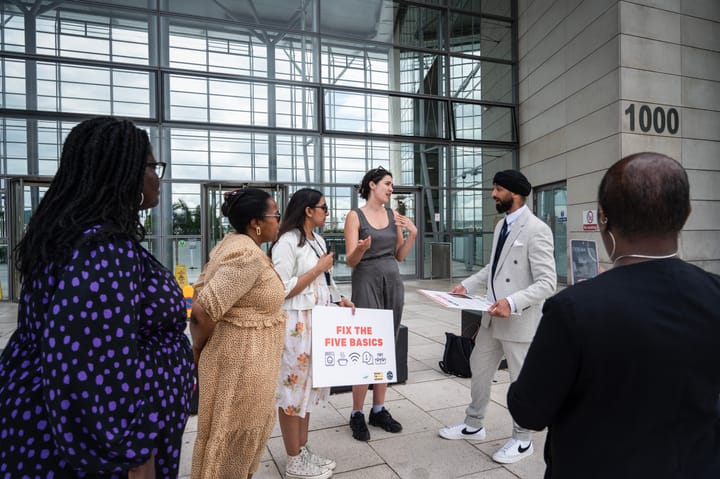
It was a question asked by an exasperated resident, cutting to the heart of a lively discussion held at the New Cross Learning Library, during the last week of the Telegraph Hill Festival.
It was a launch event for Neoliberalism and Urban Regeneration - London's Communities Finding a Voice and Fighting Back, a new book by Dr. Roger Green and Prof. Keith Popple.
But the mood in the room felt less like a standard academic book launch and more like a chance to evaluate the tactics of a community pushed to its absolute limit.
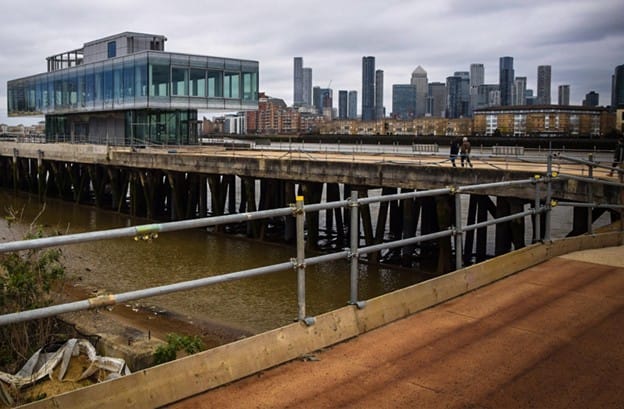
For nearly two decades, the 40-acre expanse of Convoys Wharf has tested the patience of Deptford. Hidden behind a formidable brick wall that literally cuts the community off from a large part of its own historic riverfront, the former Royal Naval Dockyard has sat largely derelict.
As the site awaits a promised 3,500 homes, Voice4Deptford (V4D) - a grassroots coalition of residents, historians, and campaigners - has fought a gruelling battle against Hutchison Property Group, a billionaire-backed developer pushing to fill the space with generic luxury towers.
Green, who has a visiting post at Goldsmiths university and works closely with the V4D campaign, and Popple’s book uses V4D’s struggle to examine what they describe as "capitalism with the gloves off"- a modern regeneration system that inherently prioritises developer profit over local needs.
Reading the book as a Deptford resident is a validating experience; it takes our hyper-local frustrations and contextualises them as part of a brutal, UK-wide economic formula. As panel chair Jill Mountford aptly noted: "If ever there was a time for a book like this, it's now."
What makes the discussion so vital is its honesty about the sheer exhaustion of campaigning and civic duty. For years, V4D Chair Malcolm Cadman and other volunteers have employed a "horizontal" strategy: playing by the rules, poring over dense planning jargon, forcing polite meetings, and raising funds to lodge a claim for a judicial review. It is a painstaking form of advocacy that has undeniably bought the community crucial time.
But Cadman was the first to admit that V4D hasn’t secured any major victories while operating within a system the authors label "the most dangerous cultural hegemony" of our lifetimes. The resident’s heavy-hearted question about direct action captured a shifting tide: after decades of playing by the rules and staring at a brick wall, have we simply been conned into polite stagnation?
Sign-up for our free weekly newsletter - Salamander News in your inbox
Neoliberalism and Urban Regeneration offers a path forward. Drawing on Italian theorist Antonio Gramsci, the authors call for "organic intellectuals"- everyday residents using their unique skills to demand accountability. The book acts as an archive for the history of Deptford’s fight back, a blueprint for other communities to follow, but crucially it also leaves room for "vertical" defiance (direct, oppositional action) alongside the vital engagement work V4D have undertaken.
We have already seen flashes of this “vertical” defiance. Last year, developers attempted to generate positive PR by hosting an immersive theatre production in the site's historic Storehouse - the first time it had opened the gates for what developers call a “meanwhile use”.
Instead of letting the developer control the narrative, local group Deptford Docks Coalition (DDC) launched a boycott of the event. DDC hijacked the production's online traction to highlight the irony of the situation: a billionaire-backed developer was handing the space to a company founded by an oligarch’s daughter, while actively pricing out the local community.
While it's unclear if that boycott roused wider local energy, Cadman acknowledged space for other tactics. In its call to “seek total community involvement,” the book posits that we need negotiators at the table, artists inspiring alternative futures, and activists willing to rattle the gates.
Green and Popple conclude with a clear message: “Don’t be intimidated by developers and their consultants in suits, politicians who say they know what’s best for you, and planning officers making decisions behind closed doors.”
As the GLA’s newly announced emergency housing package offers further protection to developer profit margins, at the expense of requirements for them to build social and affordable homes, the advice is more urgent than ever.
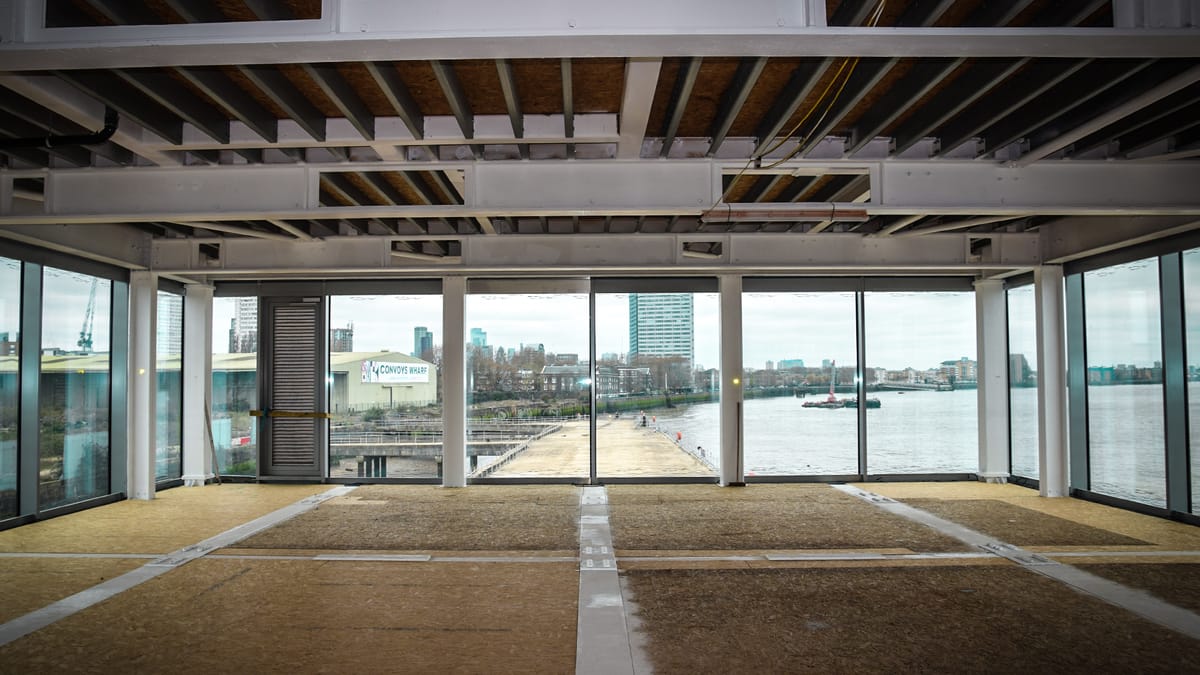
While Cadman remains hopeful about recent signs of improved community engagement from the developers, others in the room seemed distinctly less convinced. Either way, after over 20 years, the only thing built at Convoy's Wharf is an empty glass show room. As this essential new book argues, there is still time to decide what kind of city we actually want to build.
Voice for Deptford's alternative vision for Convoy's Wharf
Cadman later outlined the impact that V4D has had in developing an alternative vision for the build out of Convoy's Wharf.
The group has worked with Bartlett School of Planning UCL urban design students for several years, to develop a Framework that has led on to their Masterplan for the site.
A new year group of students will be updating this during April.
Cadman added that V4D raised a judicial review to challenge Hutchison's planning application on whether it had timed out, normally five years for a large scheme.
The developer was granted planning permission in 2014, and the S106 was agreed in 2015 under Boris Johnson.
The legal challenge was unsuccessful, but revealed that the developers had been given an initial 10 years, "plus another three years if needed, and then yet another two years" ie 15 years total.
It is 12 years since planning permission was granted, so Hutchison have time left with the current planning permission.
Cadman noted that despite the extended planning permission period, Lewisham council decided there was not enough time for the 22 plot applications to be taken through the full planning permission process.
V4D expect that Hutchison's revised plans for Convoy's Wharf will propose an even denser and higher proposal, and Cadman expressed concern that developers will evoke a Section 73 notice to push forward their plans in a new form, as recently happened at Canada Water in Southwark.
Malcolm Cadman is standing as an independent councillor in Evelyn Ward in the May 2026 local elections.
Neoliberalism and Urban Regeneration - London's Communities Finding a Voice and Fighting Back is published by Bristol University Press.
The National Housing Demonstration 18 April https://www.housingdemo.org/
Sign-up for our free weekly newsletter - Salamander News in your inbox