Lewisham council will 'explore' Rights for Nature .. but campaigners call for practical action now
The council declared an urgent need for climate adaption, biodiversity recovery and river health recovery and will look into Rights for Nature. But campaigners have repeatedly called for practical steps to be taken now.
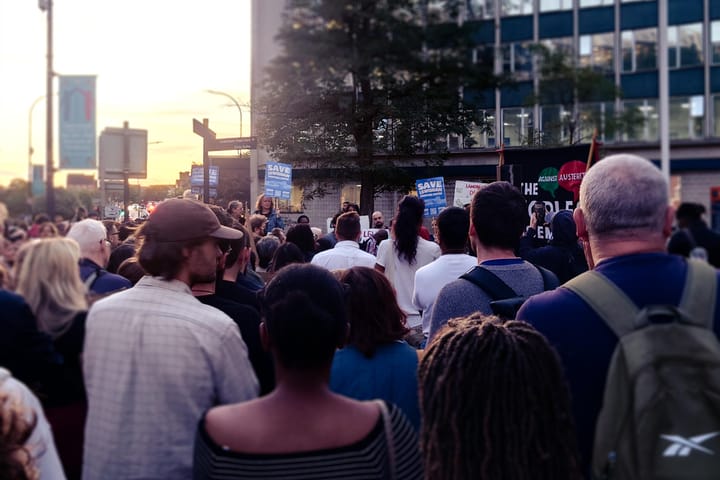
The Lewisham council meeting on 23 September was dominated by the debate (between councillors themselves) about the petition brought by Save Lewisham Shopping Centre campaigners.
The Greens struggled to explain how their planning policy would differ from the policy of the previous Labour administration.
But at the end of the meeting, a motion was passed in which the Greens seemed to be on stronger ground.
Robin McGhee, councillor for Ladywell, proposed the motion which declares "an urgent need for climate adaptation, biodiversity recovery and river health recovery".
It continues to list the ways in which the council should act on this.
Point 5 suggests that the council start exploring a Rights for Nature framework for the borough "including in relation to rivers, open spaces and trees".
This would give legal recognition and "personhood" to natural entities such as rivers.
Rights for Nature is a legal concept with growing support in the UK. It has been fully implemented in Ecuador, where it has been used in court to protect nature across the country, and some English councils have begun to use it.
As barrister Paul Powlesland points out, in a "testimony to the ingenuity of English lawyers", we have given legal rights and personhood to companies but not to natural entities such as trees and rivers.
The Rights for Nature motion was trailed at the Sustainable Development committee meeting on 9 September. While the first part of the meeting was devoted to the Climate Action plan, the second half reviewed ecological governance and participatory budgeting.
Threats of new planning legislation to biodiversity
Eszter Wainwright-Déri, the council's ecological regeneration manager explained that the council works in partnership with groups, individuals and biodiversity partnerships, but has limited influence over privately owned lands.
She noted the cumulative effects of climate change on Lewisham's habitats and species and pointed out that changes in planning legislation which came into force in August will make things worse.
Government planning legislation introduced in 2024 aimed to ensure that construction projects compensate for any loss of nature by achieving a 10% net gain in biodiversity or habitat, either on site or somewhere else.
But to the despair of environmental NGOs, this has been amended to exempt smaller development sites - the majority of English developments - from the Biodiversity Net Gain (BNG) requirement.
Support local independent journalism from just £2 per month or leave a tip.
What is participatory budgeting?
The second update was from Vince Buchanan, head of parks and open spaces, who introduced the council's move to participatory budgeting as part of "a more inclusive approach".
He described it as "giving residents a more meaningful role in shaping priorities and developing ideas and influencing .. how a defined pot of money is used."
He argued that engagement can be dominated by people and groups who already know how the systems we operate in work, and it needs to reach "beyond the usual voices that we're all probably familiar with".
He mentioned the work the council is undertaking in the new National Lottery Heritage-funded Nature, Towns and Cities project. The council was awarded the grant under the previous Labour administration.
The funding had a stated aim to boost health and wellbeing and increase participation and use of green space from a wider, more diverse group of residents.
The council has already employed two officers to work full-time on outreach work, liaising with residents in underserved communities.
Community groups in Downham have told Salamander that they believe council officers blocked their own bid for the Lottery funds for address health inequalities and restore nature, before going on to present their own bid.
If this is so, then clearly resident engagement is not supposed to go too far.
Buchanan insisted that the "important learning is not just who gets funded, but who takes part, who does not, what support is needed and whether the process genuinely reaches people outside of the usual networks .."
"The risks with participatory budgeting are that we will have the same people come forward and they will know how to articulate their argument," he warned.
Jez Hall from Shared Future CIC offered his experience of the approach, saying that Scotland has taken it furthest, linking it to its Community Empowerment Act.
In mainstream participatory budgeting, residents are shaping the service and investment of local government and direct a portion of budgets, Hall said.
"It is resource intensive at the start .. Councils need to train officers and design processes, in order to get new people to participate."
He argued that it is not a form of consultation, but a power shift with "social capital building elements" and has to be based in people's priorities. He gave examples of extreme heat, draughtproofing, green spaces.
Suzannah Moore, Labour councillor for Grove Park, raised questions about the amount of officer time involved, the inclusion of cross-section of residents and genuine effectiveness of the approach.
Hall referenced citizens assemblies and councils who have modelled this.
However, councils that have tried to implement citizens' assemblies have found that there are high costs associated with overcoming barriers such as work and caring responsibilities, in order to get a representative section of the community involved.
But along with a lack of clarity on the costs of participatory budgeting, there was a lack of acknowledgement of how much Lewisham council depends on volunteers to assist with running its services, and recognition of the financial and social value their work provides.
The member groups of Lewisham Biodiversity Partnership delivered 18,348 volunteer hours in 2025.
Paul de Zylva, chair of Quaggy Waterways Action Group (QWAG) told Salamander that he had already reproached officers regarding their attitude towards community volunteers, "patronising them with praise while regarding them as unrepresentative and/or too knowledgeable".
He directly challenged Buchanan's position that Friends of Parks groups are unrepresentative "and that there is somehow a problem with community groups that know the system".
Sign-up for our free weekly newsletter - Salamander News in your inbox
QWAG demands which council can 'get on with now'
"While the council explores the rights-based approach, it can get on with the straightforward actions already before it", de Zylva said. "There are major schemes that have been on the cards for decades and are routinely ignored or put on the back burner."
He summarised some of QWAG's demands:
- "Proper restoration across the catchment - such as the still buried Quaggy in front of Lewisham police station - right up to the major opportunities to restore rivers upstream to create flood storage, restore nature and improve local areas.
- "Back a proper pollution monitoring and reporting system for the public to use and have faith in.
"The current pollution monitoring is not fit for purpose, is unresponsive, and deprioritises the routine pollution that is common in this catchment because it is focused on major, single pollution 'episodes' such as large sewage spills and oil spills, which are uncommon in this catchment.
"It's the daily, routine pollution that is the problem, but this is not considered serious enough to act on ..
- "Proper cooperation with neighbouring boroughs (Bromley, Croydon, Greenwich), to address issues affecting their shared rivers and water environment."
"We're still waiting to hear from the council on the 5 initial points we raised with all councillors in our welcoming letter of 21 May," de Zylva says. "So far, they are continuing the silent treatment we had under the last administration.
"QWAG is still waiting for evidence that the council is committed to and actually will act on the poor to moderate (at best) ecological state of local rivers and waters."
Sign-up for our free weekly newsletter - Salamander News in your inbox