Re-imagining Deptford Creek: Eleni Mente’s Sentient Edges
A workshop at the BPTW architects' open studio asks: 'What if we gave more room to the river?'
This summer, a public workshop at BPTW’s architecture practice on Norman Road brought residents and industry professionals together to reimagine the area around Deptford Creek.
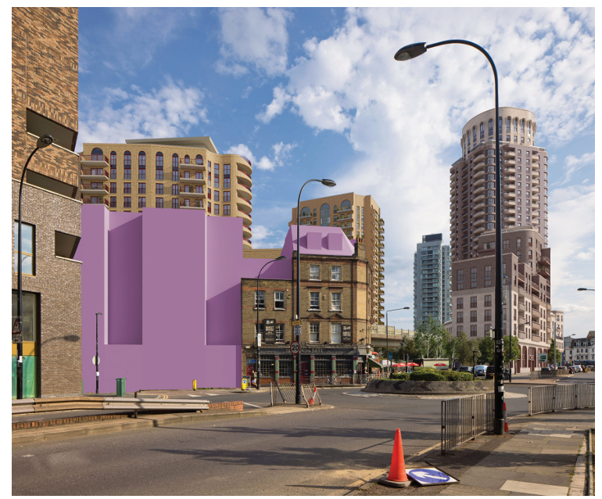
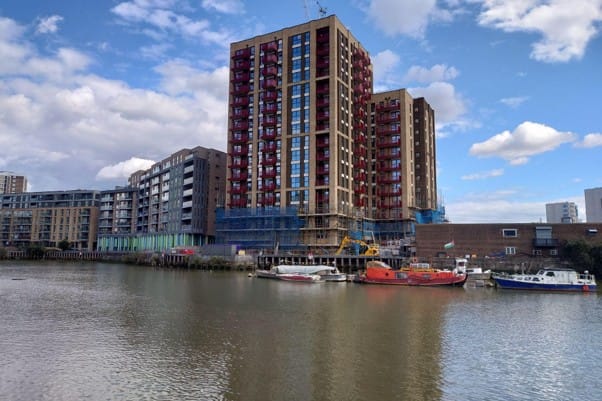
Transformation is already reshaping both sides of the creek. The 145-unit stepped residential tower at Saxon Wharf on the Greenwich side will be completed this autumn.
Deptford Reach - a huge 800-home, eight-tower plan on the former Lewisham College site that spans both banks - was refused planning permission by Lewisham council on 24 September, principally on Heritage and Urban Design grounds.
But it will continue to be a deep concern for lovers of the creek, as the plans will now be referred to the Greater London Authority (GLA) and government ministers.
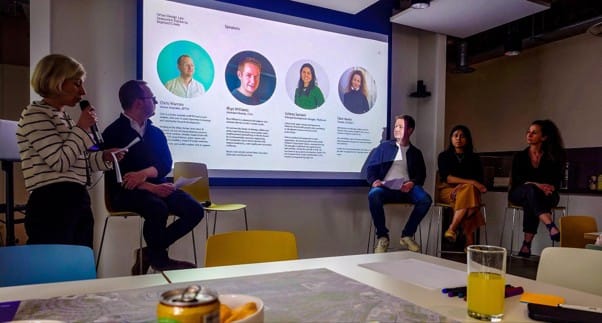
As part of the London Festival of Architecture in June, BPTW’s event was a chance to pause for thought. Advertised as a participatory "Urban Design Lab", rather than presenting finished masterplans to the public, organisers Ana McMillin and Scott Adams invited residents into an open dialogue.
They brought together a panel that included representatives from across the industry - architecture, structural engineering, property development, and landscape design - to discuss the future of this designated GLA Opportunity Area.
The panel included Rhys Williams, a civil design engineer and Associate Director at engineering firm Civic, to ground the conversation in practical realities. His experience - as well as the business-minded contributions by Ushma Samani, principle development manager at Platform 4, helped the visionary concepts presented by landscape architect Eleni Mente stand out even more sharply, signalling that her ideas didn't have to remain just a dream.
Eleni Mente's Sentient Edges
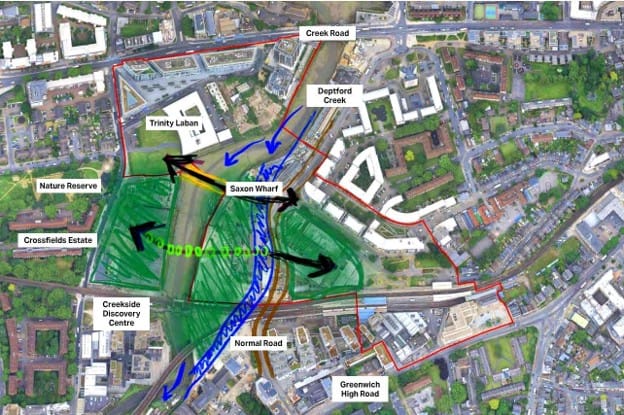
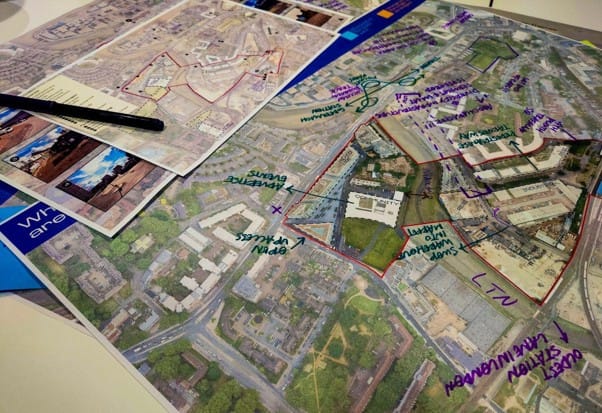
During her presentation, where around 30 people were clustered around tables with maps, pens and post-it notes laid out, Mente proposed a concept she calls Sentient Edges.
She explained: "There is a profound difference between a natural boundary and an artificial border. The creek creates a natural, tidal boundary - that is its geography.
"But the moment we encase it in vertical walls, we construct a border. A border keeps people out, locks nature away, and breeds fear of the water rather than stewardship."
Mente’s thoughtful and beautiful delivery of such an idea filled the room with a palpable enthusiasm. Instead of fortifying the creek out of fear, she asked the room to reimagine our river edges "not as hostile barriers, but as vibrant places that encourage us to live with nature" - creating a defense that "protects, but also inspires".
It is tempting to dismiss such ideas with an instinctive "that would never work.". But the real achievement of BPTW’s workshop was that it carved out a rare collective space for this kind of ambitious thinking.
Developers have been quick to market Deptford’s proximity to the creek as "luxury riverside living", whilst the actual experience for residents at street level is one of near exclusion.
Flood defences for a macro-tidal estuary
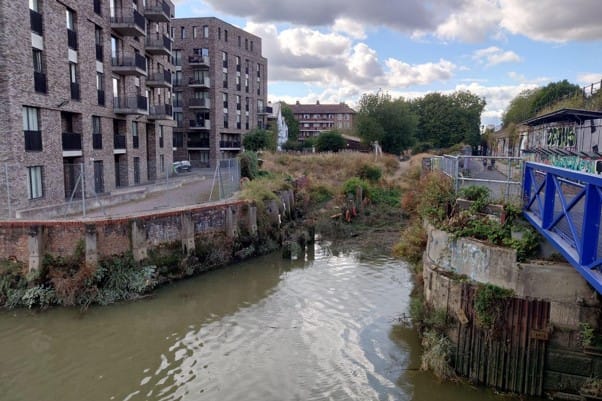
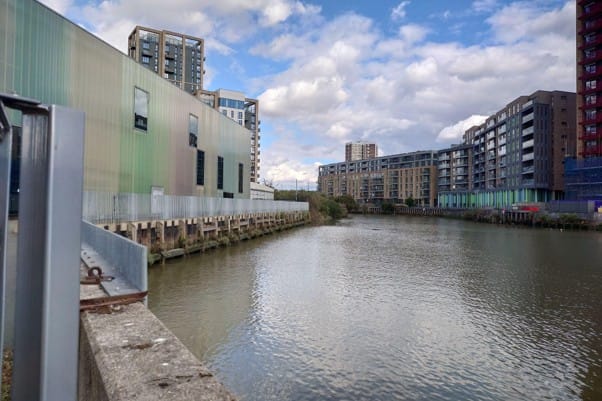
The creek remains heavily barricaded behind a combination of concrete, steel, and timber fendering acting as tidal flood walls. This reality stands in stark opposition to Mente’s core design philosophy, which treats every location as "a shared space where people, plants, and animals coexist in harmony".
The impulse and need to fortress the creek is understandable. Deptford Creek is a macro-tidal estuary where the river swells by up to seven metres twice a day. Its concrete borders protect nearby properties from flooding and from the likely contaminated ground left behind by centuries of heavy Victorian industry.
Although once all of London's estuaries had borderless, natural banks, today only 2% remain. The historic containment of our estuaries also led to a narrowing of these areas, referred to as "encroachment".
The project Estuary Edges explains "encroachment typically reduces the amount of water the channel can safely carry, leading to higher water levels, increased velocities, increased risk of flooding and erosion.
"In addition, it has led to the loss of large areas of tidal foreshore, which is an important habitat of national and international significance."
In Deptford, we are extraordinarily fortunate to have the Creekside Discovery Centre, its low-tide wader walks, educational tours and meadow of wildflowers have kept part of our local ecology alive for decades.
One small edge of the creek is free of a "border" at the Creekside Discovery Centre.
To soften more of the creek's edges, the Environment Agency has worked to install stepped "intertidal habitat terraces" which act like "living walls". If you peer over the edge at various access points along the creek, you will spot them.
At a planning meeting in February, where Lewisham councillors considered developer YourTribe’s Sun Wharf scheme, local councillor Dawn Atkinson raised concerns that some of these habitats, designed to support Sand Martins, Kingfishers, bees and other insects, were at risk.
Your Tribe agreed to provide an ‘appropriate replacement’. Councillors approved the plans.
Without meaning to diminish the importance of intertidal habitats, Mente argues that these small interventions ultimately fall short of delivering the comprehensive benefits the creek could offer to both the community and the local ecology.
"The thing is that this approach is thinking only of the [hard] edge," she told me.
"It's not a holistic, zoomed-out view of the neighbourhood. How much access is there to the creek? Can it be a space of its own? Not just asking how we can soften up the edges only."
Sentient Edges - Mente’s lessons for Deptford
I met with Mente after the workshop to discuss her ideas in more depth. Her work on "Sentient Edges" looks beyond defensive fortresses, proposing "living shorelines" that absorb and decelerate floodwaters while creating accessible public space.
The model draws on major international precedents. She has studied the landmark Room for the River initiative in the Netherlands, where engineers set back dikes and excavated secondary channels to give the water space to spread. By widening the river corridor, flow velocities dropped significantly, simultaneously mitigating regional flood risk and creating an expansive waterfront parkland.
The Dutch model proves the value of giving water space, though the Thames Estuary presents its own unique and ferocious challenge.
Heavily walled throughout London, the Thames funnels a massive volume of water directly into tributaries like Deptford Creek, creating a tidal range up to three times larger than at the Dutch coast.
However "sentient" stepped, set-back tidal terraces could be built into the edges to safely absorb the daily surge in the creek, meeting statutory safety levels while giving the community back its shoreline.
Support local independent journalism from just £2 per month or leave a tip.
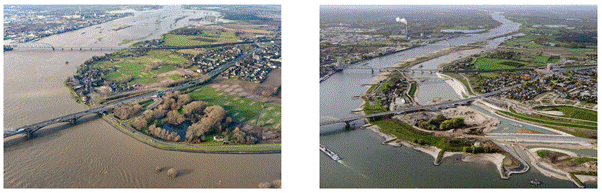
Mente observed an even more stark lesson during her field research for the MetaBiosis Lab in Japan, following the 2011 tsunami.
The government’s immediate reaction was to build or reinforce concrete seawalls - structures Mente describes as 'lifeless barriers' up to 15m high, that trapped historic fishing communities behind grey fortresses.
Mente offered me a lesson over our drink: fighting water with concrete is a losing battle. "How high can you build the next one? Twenty meters? Fifty meters? Then you have no connection to the ocean anymore. You're surrounded by walls. That's not what we want."
The solution, she notes, is accepting that "the water will find its way. We cannot avoid that. The logic is that we slow it down."
In response to the tsunami, designers and community volunteers began pioneering Disaster Preventive Parks. 34,000 volunteers planted multi-layered coastal mini-forests as part of the Millennium Hope Hills project along Japan's northeast Pacific coast.
Mente observed that "the greater nature’s force, the stronger the community became". She argues that our boundaries must act as "canvases for culture and nature" - green layers (like the coastal forests) that will absorb energy, slow the water's force, and restore community life to the shoreline.
Mente is under no illusion that all walls should simply vanish - for Japan or the creek. But while Deptford may not face Pacific tsunamis, the surrounding area sits heavily within Flood Zone 3, facing very real threats from tidal surges and surface water runoff.
Yet, the core safety principles remain identical: constricting water accelerates its destructive power, while giving it room allows us to safely live beside it.
Reclaiming public imagination… and power
Lewisham Council's River Corridor Improvement Plan SPD, adopted in 2015, echoes this, calling for "re-aligning or setting back tidal flood defence walls and improving the river frontage to provide amenity space, habitat, access and environmental enhancements".
Mente is highly pragmatic about the forces shaping these waterfronts. "We live in London and I think everyone should know that this is a capitalist city," she notes, acknowledging that developers ultimately "need to pay back" to build.
As she points out, whether we like it or not there is an appetite for developers to fund these wetlands and nature reserves because it directly increases the market value of the luxury flats they are building next to them.
As Rhys Williams noted during the BPTW panel, forward-thinking engineers have the technical capacity to design edges that meet statutory safety levels.
But during this Thursday’s planning committee meeting at Lewisham Town Hall, Kelvin Shewry, chief executive of the Creekside Discovery Centre asked councillors to refuse the plans for Deptford Reach, until the ambition on environmental improvement was raised to meet the ambitious scale of the masterplan.
What is missing is perhaps sufficient public pressure on the developers, the Environment Agency, and both councils to treat the creek as an interconnected natural asset rather than a collection of fragmented private plots.
With Lewisham's Green administration just this week passing a “Rights of Nature” motion that declares "an urgent need for climate adaptation, biodiversity and river health recovery," now is the undeniable moment for the community to demand more room for the river.
Events like the Urban Design Lab should not remain occasional festival conversations.
As Mente insists, the architectural vision is ready, but "we as designers cannot do it if the local people are not involved." If we want future generations in Lewisham and Greenwich to grow up with living, accessible waterways, we must advocate for them.
"We're not dreaming," Mente says. "We're still talking about reality. But it's the bright side of reality."
Sign-up for our free weekly newsletter - Salamander News in your inbox