Deptford housing campaigners take Lewisham council to court
The Save Scott House campaign took their case to the High Court in a challenge to the council's permission for a 31-story student housing tower block.
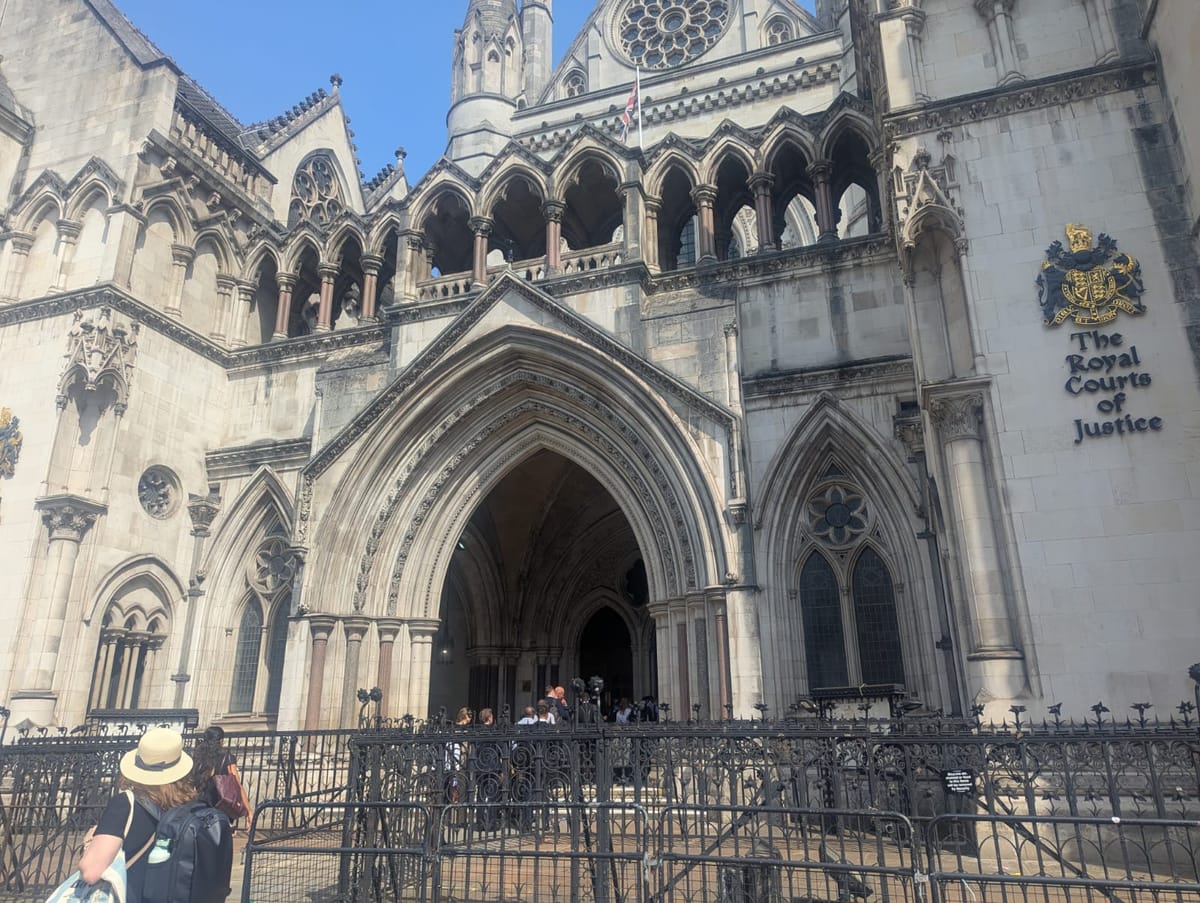
Save Scott House campaigners filed into the Royal Courts of Justice on 23 June to attend the Judicial Review of the Scott House planning approval.
Kenneth, a member of the campaign, was named as the claimant taking the legal action against the London Borough of Lewisham, which approved the development of Scott House in November 2024.
Developer YourTribe (part of the huge Aitch Group) has evicted the tenants from the Edwardian building, which was locally listed in March 2020.
YourTribe now plans to demolish it and build a 31-story tower of 502 student bedrooms on the site.
The hearing took place at the start of London’s second, alarming heatwave of the year, which coincided with London Climate Action Week and led to cancellation of some planned climate events.
The judge gave permission to the King’s Counsels (barristers) to take off their wigs and gowns, but under the pressures of longstanding legal etiquette, none of them did.
Housing campaigners’ case: ground 1 - no evidence of need
Jenny Wigley KC told the judge that the claimant was a local resident, a founder and trustee of Pepys community hub and that they were particularly concerned about the loss of residential units.
She set out the first ground of the claim, relating to planning policy conditions intended to avoid speculative development.
She argued that YourTribe – the student housing arm of Aitch Group – had failed to demonstrate the need for student housing by nominating a Higher Education Provider (eg a university) which wanted to use the accommodation.
She said the firm had therefore failed to comply with the Lewisham Local Plan (finalised since the planning approval), section H07 on Purpose Built Student Accommodation.
It describes various conditions which need to be met in order for the council to support PBSA proposals. This includes the condition “the accommodation is secured for use by students, as demonstrated by an agreement with one or more specific higher education providers.”
Wigley said that planning officers had failed to advise the councillors on the planning committee of these conditions in the Local Plan, before they agreed the S106 agreement in October 2025, giving formal permission for the development to go ahead.
Officers included a letter of support from Trinity Laban dated 17 August 2023, two years before the planning permission was granted, but she described this as “nice warm words” without a commitment to taking on student housing.
She said that the policy, including the need to have identified an end user, was intended by the council to protect the borough from development that does not serve its purpose and to avoid the “potential mischief that may occur”, including speculative development and running the “running risk of dereliction”.
She argued this had to take place before development began, in order to serve its intended purpose, and therefore "the S106 does not comply with the Local Plan".
Ground 2 – YourTribe's responsibilities towards its tenants
Barrister Claudia Hyde, described by Jenny Wigley as her "learned junior", presented the second ground of the claim, which related to YourTribe’s commitment to provide support to the tenants who were served eviction notices.
When the Scott House planning application was granted in November 2024, there were 19 occupied homes in the building, housing around 60 residents. These homes were 2-bedroom and 3-bedroom live/workspaces.
2- and 3-bedroom homes are in high demand across Lewisham, and are a considered a priority in the Local Plan.
YourTribe's plans required eviction of the residents - which has now taken place - and demolition of the existing homes.
Claudia Hyde went through the chronology of events, explaining to the judge that this was critical to understanding the irrationality of the council decision to grant planning permission.
At the planning committee meeting of 7 November 2024, councillors were highly concerned about the support to be provided to tenants who were to be evicted, and the process to be followed.
They discussed the high levels of need for the types of homes that were being lost.
Committee members took particular interest in YourTribe’s responsibilities to help the tenants find alternative accommodation and insisted that the wording describing this be as strong as possible.
They upgraded the text from making "reasonable endeavours" to making “all reasonable endeavours”.
YourTribe is part of Aitch group which has a very large portfolio of different tenures of property across London, so it would seem to be uniquely able to support tenants in finding alternative accommodation, if it wanted to.
Claudia Hyde explained that Section 21 eviction notices were served on tenants on 10 June 2025, before the section 106 was published even in draft, and before formal planning permission was issued.
The following day (11 June) tenants received some information by email, including lists of estate agents and points of contact.
YourTribe described this email as “the Relocation Strategy” in their witness statement.
But Hyde argued that the Relocation Strategy was a document that the developer should have submitted to the council for its approval, as part of the S106 agreement.
She gave examples of requests by different tenants to stay until the end of their short term tenancy, which were immediately refused.
The draft S106 was published on 19 August, including a draft description of the relocation support that YourTribe said they would provide.
Four months later, after the tenants had been evicted, the final S106 was published, including the relocation strategy that described the protections for the tenants.
Hyde pointed out that the process whereby the council would review the strategy, request changes, and possibly strengthen it, to meet the "all reasonable endeavours" commitment, was weakened.
YourTribe argued that it had already done everything it would have done to support tenants, and everything it considered necessary.
But Hyde said: “This procedural safeguard was watered down, because the strategy was submitted at a time when tenants had already left.”
Join the co-op and support local independent news from just £2 per month.
The council's defence - the need for more PBSA
The first defence barrister began with the arguments about the strategic requirement for PBSA across London, the "tilted balance" in Lewisham and the "2.5 ratio" of student housing to homes.
These arguments and this interpretation of the formula were challenged by Caitlin Colquhoun, from Southwark Law Centre's Planning Voice project, at the Scott House planning committee meeting in November 2024.
The defence barrister argued for a different understanding of the nomination agreement, emphasising instead the right of a university to allocate a room to a student.
He then argued that the Lewisham local plan is silent about when the nomination agreement needed to be secured, but the London Plan suggests that the nomination agreement is likely to be about 5 months before occupation.
[However, the London Plan also refers to a risk that PBSA provision could become ‘disproportionate' and the need for an HEP to “link provision to HEP recruitment plans, providing a necessary feedback loop".
It is not clear how the "feedback loop" would work if the nomination agreement happens when the development is almost complete.]
YourTribe witness statement - robust demand for PBSA
Phoebe Juggins, senior planning manager for Aitch Group and YourTribe, had made a witness statement to the court, arguing that there was continuing demand for more PBSA in the area.
She has made these arguments for YourTribe at many Lewisham planning meetings, most recently the application for 605 student bedrooms at Sun Wharf.
Sun Wharf was YourTribe's eighth PBSA development in Deptford, Salamander examined whether the HESA data backs up the claim.
"Not a planning concern, a moral concern"
The second barrister for the defence read out a letter from Geoff Whitington, development management officer from Lewisham Council, responding to points made by Save Scott House Campaign.
He stated that there did not need to be a nomination agreement to prevent speculative development, then argued from many different angles that the relocation strategy in the S106 agreement was well-founded, even if it was agreed months after the tenants had been evicted.
He added that anyway, it was academic when there was no-one left to relocate.
He claimed there was "no public interest in this case being heard" due to it being "highly specific and on a single development".
But campaigners argue that on the contrary, it is a test case about over-concentration of PBSA and the council's ability to manage developers.
Finally Whitington added, "schedule 8 does not address a planning concern, it addresses a moral concern".
Two further barristers for YourTribe then add to the defence.
The first argued that the claimant's position “would seriously hamper deliver of PBSA in Lewisham. This is not how PBSA works”.
He stated that no-one knows exactly who will occupy a development before it is built, whether it is affordable housing or any other kind, but that the developer would never risk it if they didn’t think they could fill it.
The next barrister argued (again) that the claimant's second ground was hopeless, he agreed with the defendant on this, it was "academic, the tenants have successfully relocated".
'Purpose of policy .. to avoid speculative development'
Following a lunch break, we trooped back into our places.
Jenny Wigley KC responded to the defence points. She referred to the Lewisham Local Plan which "uniquely and newly requires" that the developer “robustly demonstrates an agreement with the HEPs”.
"The purpose of the policy .. is to avoid speculative development .. and dereliction," she said.
"Neither of my learned opponents have given a real response to how without this nomination agreement, that purpose can be achieved."
By building PBSA, they were losing an opportunity, for example, for affordable housing, she continued.
"My learned friend said there's nothing special about Lewisham .. but the recently adopted Lewisham Local Plan points to significant amount of PBSA recently completed in the borough."
She referenced the rise in development of PBSA in the area, saying that it is critical that the council don’t suppress development of other kinds.
She said the nomination agreement can be made conditional on when construction starts or other milestones, "neither of my opponents addressed this".
At least one of the tenants is 'effectively homeless'
Barrister Claudia Hyde argued that the discussion the court had heard, and vagueness about the meaning of flexible tenancies "underscores importance of council providing feedback" on the relocation strategy [which it was unable to do].
In her final point, she countered the argument that ultimately it didn't matter, as the tenants had “successfully relocated”.
"I'm not sure what is meant by that," she said "but refer to Kenneth Ibrahim’s witness statement: 'I don’t know where most of them have gone but at least one is sofa surfing with friends and effectively homeless'".
The judge will deliver a judgement at a later date.
Support local independent news from just £2 per month.