
London’s firefighters routinely exposed to carcinogens and pollutants, finds City Hall report
The London Assembly Fire Committee released a groundbreaking report on the risks that London's firefighters face.
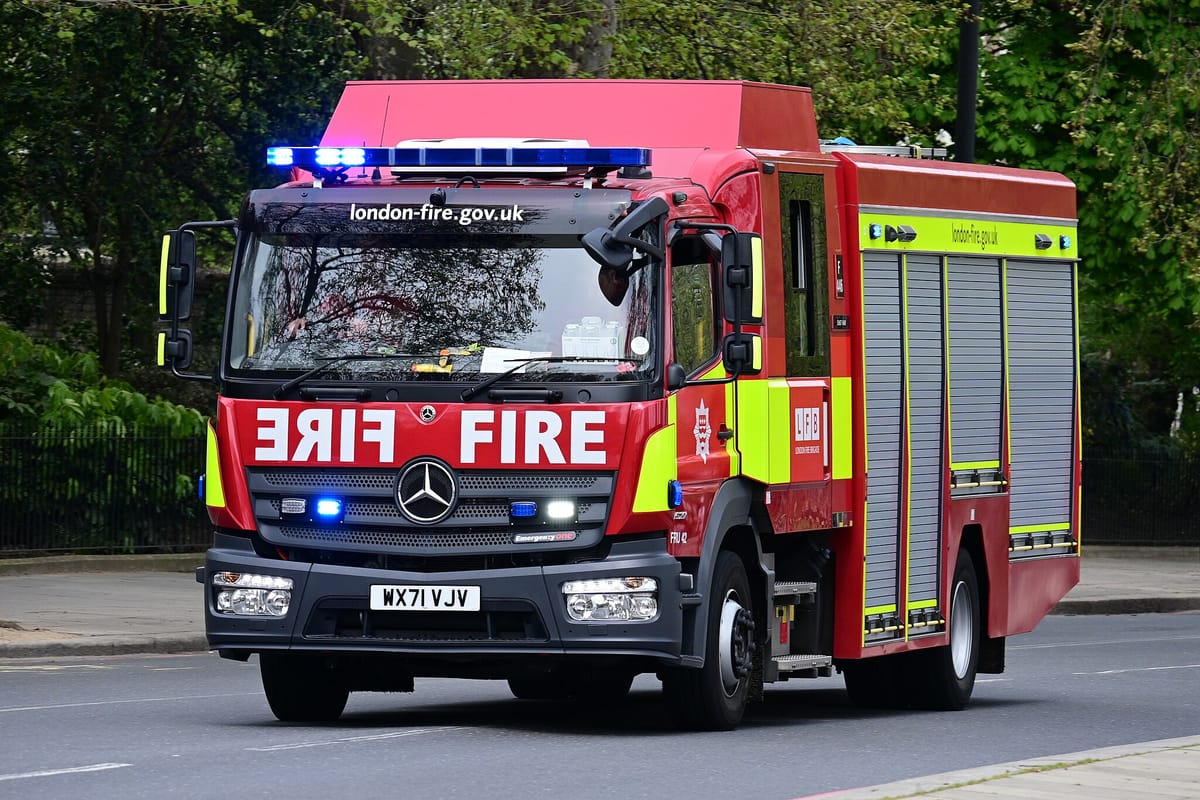
Middle-aged firefighters in London are being diagnosed with cancer at a rate three times higher than the general population, a new report has found.
Four% of people aged 35 to 39 working in the London Fire Brigade reported having been diagnosed with cancer in a Fire Brigade Union (FBU) survey, according to an investigation from the London Assembly Fire Committee.
The report – called Exposure to fire contaminants in London: A hidden, growing risk? – reveals that London’s firefighters may be routinely exposed to toxic substances released during fires, including known carcinogens such as asbestos, heavy metals and persistent organic pollutants.
While a direct link to cancer has not yet been proven, firefighters in London have both a higher cancer incidence and abnormal tumour markers compared to the general population.
Zack Polanski, who chairs the cross-party committee, said: “Fires don’t end when the flames are out as toxic contaminants can remain long afterward. Firefighters accept risk as part of the job, but exposure to toxic chemicals should not be an unavoidable consequence of protecting the public.”
“While London Fire Brigade has made real progress, this report shows more needs to be done to understand and reduce the long-term health risks firefighters face.”
In the report, released on 4 February, Assembly Members praised the LFB for ensuring “the risks posed are being managed in a proportionate and cost-effective manner” – namely, the Fire Contaminants Policy published in 2022 combined with increased risk awareness training, which has also helped drive a cultural shift away from staff seeing dirty kit as a ‘badge of honour’.
But the Committee warned that there are ongoing issues with the availability of Personal Protective Equipment (PPE) in stations across the capital.
In 2025, firefighters reported record levels of inadequate or unavailable PPE, prompting the London Fire Commissioner to tell the committee that the LFB’s inability to provide PPE to its staff was “a professional embarrassment”.
Last year the LFB attended 18,452 fires in the capital, with both industry and union figures noting that firefighters in London faced a unique blend of a “densely built” environment with significant amounts of fire retardants, plastics and chemicals combining to produce a toxic domain.
“Although danger is an inherent part of firefighting, research is now emerging which points to a growing – hidden – risk around occupational exposure as a firefighter to contaminants – most commonly encountered as the products of combustion at fire incidents – and an increased risk of contracting cancer,” the report said.
During one evidence gathering session, Gareth Beeton, London Regional Chair of the FBU, told the London Assembly: “There is not a firefighter that I talk to who does not know someone they have worked with, either on their watch or on their station, who has had a cancer.”
The committee also noted that firefighting was designated as an occupation that is “carcinogenic” by the World Health Organisation’s (WHO’s) International Agency for Research on Cancer (IARC) in 2023.
That same year, the organisation wrote: “There is sufficient evidence in humans for the carcinogenicity of occupational exposure as a firefighter. Occupational exposure as a firefighter causes mesothelioma and cancer of the bladder.
“Positive associations have been observed between occupational exposure as a firefighter and cancers of the colon, prostate, and testis, and malignant melanoma of the skin and non-Hodgkin lymphoma.”
To address this, the committee called on the Government and the National Fire Chiefs Council to take action to better understand and reduce firefighters’ exposure to fire contaminants, with one recommendation including establishing a UK-wide firefighter exposure and health monitoring programme and piloting exposure monitoring for operational firefighters in London.
A London Fire Brigade spokesperson told the Local Democracy Reporting Service (LDRS): “Our firefighters must be as safe as possible at work, and we are involved in a range of activity to better understand and mitigate the effects of contaminants on their health. This is helping the fire and rescue sector develop a clearer picture of how exposure may impact firefighters over the course of their careers and the best way to respond.
“We provide firefighters with extensive personal protective equipment and clear and comprehensive guidance on decontamination procedures. There is also regular mandatory training to ensure they understand the risks associated with contaminants and the steps they can take to protect themselves.
“We have made significant progress in how we reduce the risk of contaminants for our staff and we remain fully committed to continuing this, working closely with partners such as the Fire Brigades Union.”
A spokesperson for the Mayor of London added: “The London Fire Brigade has been actively working to address the issue of exposure to toxic fire contaminants, including improvements to personal protective equipment (PPE) and ongoing training to help staff understand the risks and the measures they can take to protect themselves. The Mayor will review the Committee’s report in due course.”
Sign-up for our free weekly newsletter - Salamander News in your inbox