Liam Shrivastava: 1000 new social rent homes and 'unequivocally pro-refugee'
Lewisham Green mayoral candidate Liam Shrivastava has plans for community-led house-building, delivering 1000 social homes and calls out the Labour government immigration raids.
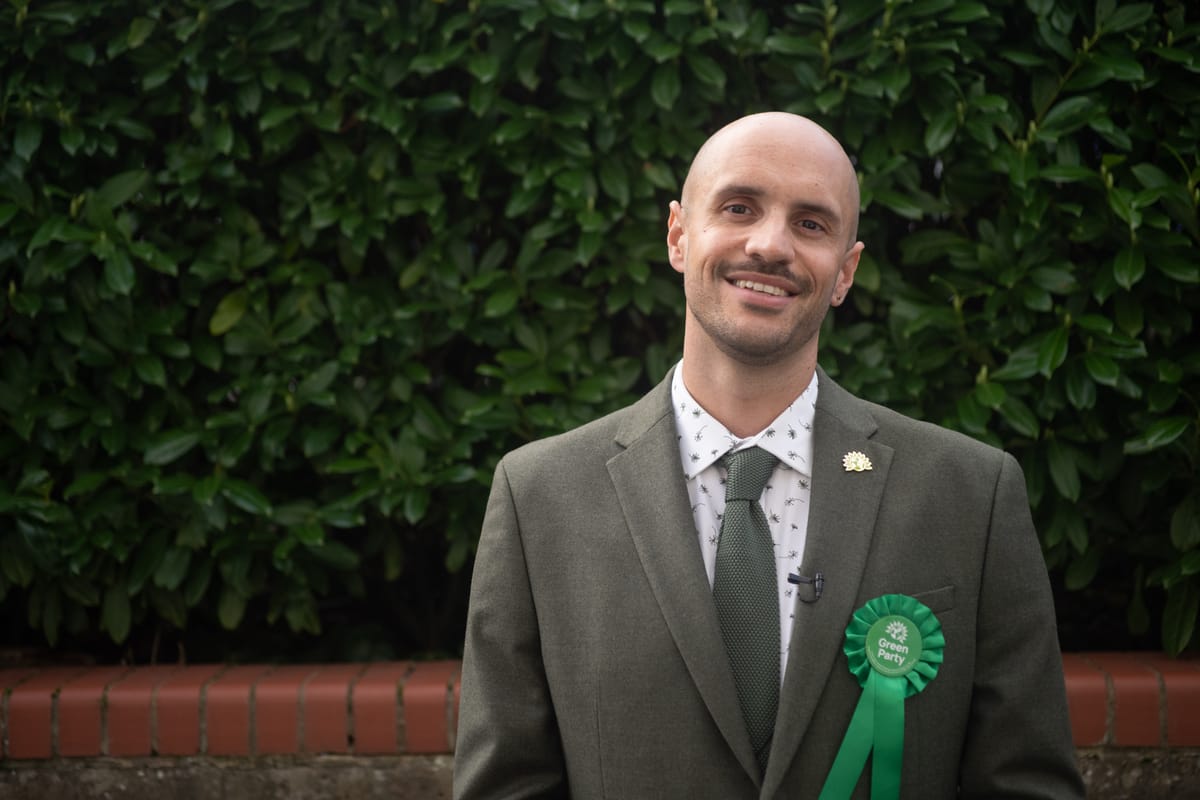
Liam Shrivastava is the Green Party mayoral candidate for Lewisham. He is currently a councillor for New Cross ward.
He was elected as a Labour councillor in 2022 and defected to the Greens in June 2025.
He also works in the Migrant Futures Institute at Goldsmiths, University of London.
Salamander met with Liam in Crofton Park and asked him our most pressing questions.
Q: There are 11,000 households in Lewisham on the waiting list for social housing, but we know that developers don’t want to build it. How are you going to address this?
A: I think we need to be tougher on developers and not accept a very low quantum of social housing.
The really obvious one is Lewisham Shopping Centre.
Any sort of objections or concerns around a development that only delivers 6% housing for social rent are interpreted by the Labour Party as being anti-homes and anti-development.
But all we are asking for is more genuinely affordable homes and a development that isn't going to drive-up land values and push people out of the borough.
Take Wandsworth, they've been able to deliver quite a high proportion of social rent homes. A Labour council in London has been able to do it, there's no reason why a Green-led council in Lewisham can't do the same.
We've pledged to deliver a thousand homes for social rent. We're going to be exploring ways of financing development so that we can deliver this target.
We could be lobbying the London Collective Investment Vehicle for ways to finance local housing. Also, things like trade union cash reserves, matched long-term ethical loans and government grants.
Another key commitment of our manifesto is promoting community-led house building. Working with cooperatives, working with community land trusts in partnership to identify suitable sites.
Lastly there is a skills shortage in terms of construction, which raises building costs.
Another pledge in our manifesto is to establish Lewisham Community Builders.
It will be a building and repairs alliance within the borough that will bring down building costs whilst creating jobs, and increasing our local capacity to build new homes as well.
Q: There are around 36,000 households in social rented housing in Lewisham. The council has a long history of failure in its handling of repairs. How did this serious neglect come about and what still needs to be done?
A: In terms of how this came about, Lewisham is not necessarily unique, but we had Lewisham Homes, which was the arm's length management organisation.
There was a total lack of oversight over Lewisham Homes. You had Labour councillors who sat on the board who were provided with information, and they failed to raise the alarm.
Over many years, Lewisham Homes failed to maintain the housing stock, they delivered a horrendous service, they had contracts with a number of outsourced contractors.
Very soon after Lewisham Homes was brought back in-house, the council self-referred to the regulator for social housing. It found a number of failings in the housing provision.
One of the key failings was a consistent underspend in the housing revenue account. They could have been spending that money on crucial major works and maintenance. They have allowed their housing stock to fall into rack and ruin.
Another big mistake when they brought Lewisham Homes back in-house, is that they should have brought the repair service in-house at the same time. Whilst we are seeing more insourcing it's not happening quickly enough and it's not happening substantially enough.
They will say it's good to have a mix, because of the specialist skills that are required. But it's another example of the council having a real lack of imagination, not being innovative and thinking, what are the skills that we need and how can we recruit those skills?
Because in general, residents have found that when they deal with the in-house repair service, they do a much better job than these contractors.
If we are going to use external contractors let's work with trusted, established firms and perhaps a builder’s cooperative to ensure that a) it's a better-quality service, and b) it's a local business that we're supporting.
Q: Salamander launched in March 25 and we have reported on many campaigns by local residents opposing intensive high-rise development - all of these campaigns have been unsuccessful.
But residents saw Blackheath getting "special treatment", and many readers told us this seems unfair. What do you think and what's your vision for future development?
A: If we look at Blackheath and the objections to the development, often those with more access to resources can hold more sway over the council in terms of blocking development.
In the strategic planning meeting, the quote from Labour's mayoral candidate, Amanda De Ryk, really highlights the different response the Greens get when we ask questions about a development, and then get accused of being anti-homes.
Amanda said a very similar thing. She said, it's not about blocking homes, but it's about ensuring we go about things in the right way.
It's interesting that Labour is able to take that nuanced position when it's something that they want to defer. But when we have questions about a development, we get accused of being blockers.
In terms of what we would do, in the local plan regulation 19 allows us to strategically tighten planning requirements, in terms of what we will consider acceptable.
We could also set a higher fast track for the affordable housing threshold, say around 45%. I also think we should be demanding a 70-30 split of social rent against intermediate.
There needs to be more joined-up thinking with planning and development.
We have a persistent overspend in social care and temporary accommodation, it is a massive cost pressure, so one of the things that I put forward in our alternative budget in March was to increase our housing acquisition programme by trying to acquire 100 extra homes that we would use for temporary accommodation.
We don't want anyone to be in temporary accommodation, but given the numbers that we have, we've got to reduce that cost pressure and improve the quality of the housing provision that we're providing for families.
Sign-up for our free weekly newsletter - Salamander News in your inbox
Q: Vision Zero - There have already been two fatal road accidents in Lewisham this year. 80% of KSI (killed and serious injury) victims are pedestrians and cyclists.
What steps would you take to increase take up of public transport and make cycling and walking safer?
A:We've very tragically had two deaths in New Cross this year, unfortunately it is to do with the lack of proper road design.
Lewisham is ranked bottom in the Healthy Streets Scorecard and has the lowest proportion of protected cycle lanes. We've put more protected cycle lanes in our manifesto.
We also want to expand things like school streets, safer crossings and more drop curbs. It's not always straightforward because you have to work with TfL and they look at it in a more holistic and strategic way.
In general, we need to reduce car dominance. I think the reason we see higher car ownership compared to other boroughs is partly the geography, but it's also to do with the lack of active travel provision.
If there was better active travel provision and better public transport provision people would be less reliant on their cars.
Q: Cars and SUVs - Car journeys in Lewisham are increasing year on year, and cars are getting bigger. A move to active travel would reduce air pollution, make Lewisham safer, reduce climate emissions and improve health.
Do you support moves to increase active travel (walking, cycling and public transport) and reduce car use, and if so how?
A: I brought forward a budget amendment to introduce a vehicle weight surcharge for larger vehicles.
There are various ways you can do this. You can either do it by weight or you can do this by capacity.
You would need to have some kind of exemptions for EVs, provided they're not SUVs.
I think having an EV exemption is important because we do want to encourage those types of vehicles over fossil fuel emission-based ones.
But what we need to do is tackle car-spreading, these large vehicles, especially if they're double parked or they're parking on pavements present accessibility issues.
Q: Education - At KS2, disadvantaged children in Lewisham have achievement 8% below London average for disadvantaged children.
Across all children, Lewisham schools have achievement below the London average at KS2, the gap gets wider at KS4 (GCSE stage) and for academic pathways at KS5.
What will you do to support schools and teachers to address this?
A: The fact that things are better at KS1 is a positive thing in the sense that those early years are very crucial in terms of educational attainment.
We would want to recognise that educational attainment begins outside the classroom. We would want to work with schools to keep improving things like breakfast club and food provision because that is really crucial.
We'd want to ensure that they're taking a child-centred approach and particularly thinking about how we can improve SEND provision.
SEND is a real problem not just in Lewisham, but for many local authorities.
It costs us a lot of money and the whole SEND system is not functioning as it should be.
It's very difficult for families to get EHCPs and I'm particularly concerned about the reforms that the Labour government is putting forward, which are probably going to make EHCPs a lot harder to get. So, we would need to work very closely with our school partners.
We need to ensure that things like youth services are properly funded. I was very disappointed that the council cut the youth service budget by £200,000 and that is soon after they've brought youth services in-house.
One thing we've committed to is that we would reverse the youth services cut - all of these things are deeply connected. We're also committed to protecting and revitalising our adventure playgrounds.
Q: Immigration, asylum and refugees - Lewisham is a Borough of Sanctuary, but Labour government policies are making it harder every year for refugees to reach this programme.
As a Green, what is your party’s position on immigration, refugees and asylum seekers to the UK?
A: The Green Party is unequivocally pro-refugee and believes in giving asylum-seekers rights, allowing people dignity, and allowing safe and legal routes into the country.
In terms of Lewisham being the Borough of Sanctuary, [Labour councillors] have been very silent on the Labour government's increase in immigration raids.
Since Labour took office, immigration raids, particularly those on local businesses, including in Lewisham, have increased 77%.
Unfortunately, Labour has completely lost its moral compass with its policies around changing the rules on indefinite leave to remain, limiting refugee status to 30 months and just trying to out-Reform Reform.
One of our commitments is that we will refuse data-sharing with immigration enforcement.
We are also finding there are issues with how migrant families are experiencing temporary accommodation and those who are on NRPF (No resource to public funds).
That is why we’ve pledged to introduce a charter of rights for temporary accommodation and to guarantee the five basics, ensuring that nobody is forced into squalor.
We have also committed to setting up a community advisory panel to support victims of the Windrush scandal and ensure that residents can access the compensation that they deserve.
Q: Safety and crime is coming up as an issue in London’s local elections.
City Hall has pushed back against misinformation and social media scares, saying that London has the lowest homicide rate in its recorded history.
In Lewisham, there has been a decrease in many kinds of crime, but there was a tragic increase in homicides, to 10 last year.
Do you believe that social media is fuelling a panic? Do you think Lewisham is unsafe and if so, what is your solution?
A: As a councillor, I've been made aware of at least two or three homicide cases in my ward in the last couple of years.
These horrendous things do happen, and we’ve got to be alive to the drivers of that type of violence from engagement with the violence reduction team.
We are aware that things like exploitation happens towards young people. We've got to take a public health approach to serious youth violence and violence in general.
I think that, yes, social media does, somewhat, fuel a moral panic. Statistically crime and the way in which London is characterised, and Lewisham is characterised, is very unfair and not true.
We also need to find ways that we can improve the life chances of young people, because if they don't have opportunities, then they are going to be more vulnerable to falling into exploitation.
We need to be better at holding the police accountable. When I was chair of Safe and Strong Communities Committee, I had a statutory duty to scrutinise the work of the police.
The police probably spends far too much of its time harassing and stopping and searching young black men, when it could be focussing on more positive, community engagement work.
Q: The NEB briefing from scientists to MPs in November 2025 tried to raise the alarm about climate and nature breakdown, and how we need to mobilise from government level down.
The collapse will profoundly affect the lives and futures of everyone in Lewisham, particularly younger people.
As mayor, you will have a powerful platform. How will you use it to help bring about the transformation that we need to address these linked crises?
A: As a mayor I would like to push forward green participatory budgeting.
We know that so many residents are concerned about the climate crisis.
Participatory budgeting brings people into the process of deciding how local budgets can be spent to tackle the climate crisis, whether that’s active travel, rewilding, or protecting a green space.
All of these things are interconnected. So many housing blocks have been neglected - we should be retrofitting those homes to make them more energy efficient, which reduces people's bills, but also reduces the burning of fossil fuels.
We should be installing heat pumps and solar panels on schools. I know some of that work is happening.
The carbon offset funding is also being underspent, I think there's at least £1m that hasn't been allocated yet. We will be using some of that money to fund things like green participatory budgeting and using Nature, Towns and Cities funding.
We would also look at offering climate bonds for residents, that could fund projects.
I will play a role in sharing that vision and encouraging other councils too.
Participatory budgeting is a really good way to give our residents a stake, especially when budgets are tight.
And also with our pension investments, with London Collective Investment Vehicle, we'll continue to push the divestment agenda - divestment from arms, genocide and from the harmful industries that contribute to the climate crisis right now.
Please support independent community news. Subscribe or leave a tip.