Is mid-rise housing the key to solving London's housing crisis?
The London Assembly Planning and Regeneration Committee advised that City Hall prioritise mid-rise housing to increase density across the capital and build more homes.
Construction is falling significantly short of the 88,000 annual housebuilding target set by the government, with both City Hall and private developers struggling against a “perfect storm” of factors when it comes to putting spades in the ground.
Sadiq Khan, the London mayor, has sought to implement radical planning reforms to stem the crisis, including slashing affordable housing quotas for developers and exploring building on poor-quality green belt land.
However, the London Assembly Planning and Regeneration Committee has now concluded that City Hall should pursue the much simpler strategy of “gentle density” across the capital in order to unlock more homes.
In a new report released on 16 March, the cross-party group of Assembly Members called on the Mayor to establish “mid-rise” developments – generally considered as five-to-nine storey tall buildings, including mansion blocks and stacked townhouses – as the preferred form of new residential building in high access locations.
During an investigation into the potential of mid-rise development in London, the City Hall committee heard that such housing can provide “human-scale density that supports neighbourliness, family life and everyday amenities” as well as “environmental advantages”, concluding: “We believe mid-rise should become the default answer to housing development in London.”
However, they also suggested that the current London Plan – the Mayor’s spatial development strategy for the Greater London area – “lacks sufficient clarity and direction” and called on the Greater London Authority (GLA) to implement a modernised density matrix, linking building height to transport accessibility.
London far less densely populated that other global cities
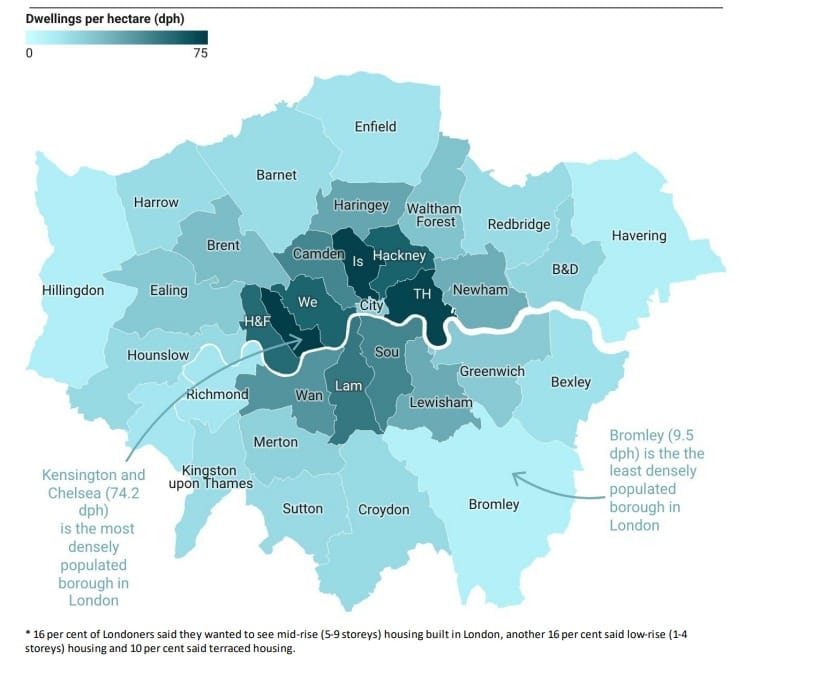
The capital is far less densely populated that other comparable global cities due to a higher proportion of low-rise buildings, with 88.3% of London’s homes being houses, bungalows or flats under five storeys tall compared to 41% in Paris, 48% in New York and 62% in Tokyo.
However, despite a “consensus on the need for more more mid-rise housing”, Assembly Members noted that the rising cost of land in London was pushing developers to build tall tower blocks so their building was financially viable.
While high-rise buildings were more appropriate next to transport hubs than mid-rise, the committee called on the GLA to help support boroughs develop planning codes that enable high-quality, mid-rise housing where it promotes “gentle” densification.

Committee Chair James Small-Edwards said: “London faces a perfect storm of pressures slowing delivery, yet the answer is right in front of us. Mid-rise housing offers the liveable, human‑scale density that residents want and that our city needs.
“Through this investigation we heard clear evidence that London should be building more mid-rise homes, and planning policy must give the clarity to make that happen.
“Our recommendations set out practical steps to support higher-quality development, rebuild trust with communities, and ensure the next London Plan provides a stronger, more strategic approach to meeting London’s housing needs.”
'The missing mid-rise'
The report referred to a paper released by think tank Centre for Cities last year, which argued that local authorities are too focused on approving tall residential towers in some areas and leaving other parts as low-density and single-storey.
It stated: “In French and Japanese cities, mid-rise housing is common throughout the urban core and is often mixed with lower rise houses. By contrast, this mixed built form is not typical in the urban cores of most British cities.
“Much more common are low density neighbourhoods composed entirely of semi-detached or detached houses, which usually only appear towards the outskirts of French and Japanese cities. The missing mid-rise is the key reason why British urban cores are less dense than French and Japanese peers.”
The authors cited the Croydon model, where the council provided guidelines for building small blocks of flats on garages, empty plots and existing properties, as an effective example of densification for other London boroughs.
However, the Planning and Regeneration Committee concluded that “guardrails were largely in Croydon’s design code and, as a result, we heard residents disliked the way in which their homes and streets changed” and said the London Plan must combine effective design codes with “quality safeguards and local engagement and support”.
The Mayor’s office was contacted for comment.
Sign-up for our free weekly newsletter - Salamander News in your inbox