How did Lewisham do in the government 'Fair Funding' shake-up?
The government's new formula for allocating grant funding to councils had wildly differing outcomes across London boroughs.
The government's planned funding for the next three years, up to March 2029, was released in the week before Christmas, showing how much core grant each local authority will get.
The government has changed the formula, which now takes housing costs into account in the assessment of deprivation, and after some reported horse-trading published provisional figures on 17 December.
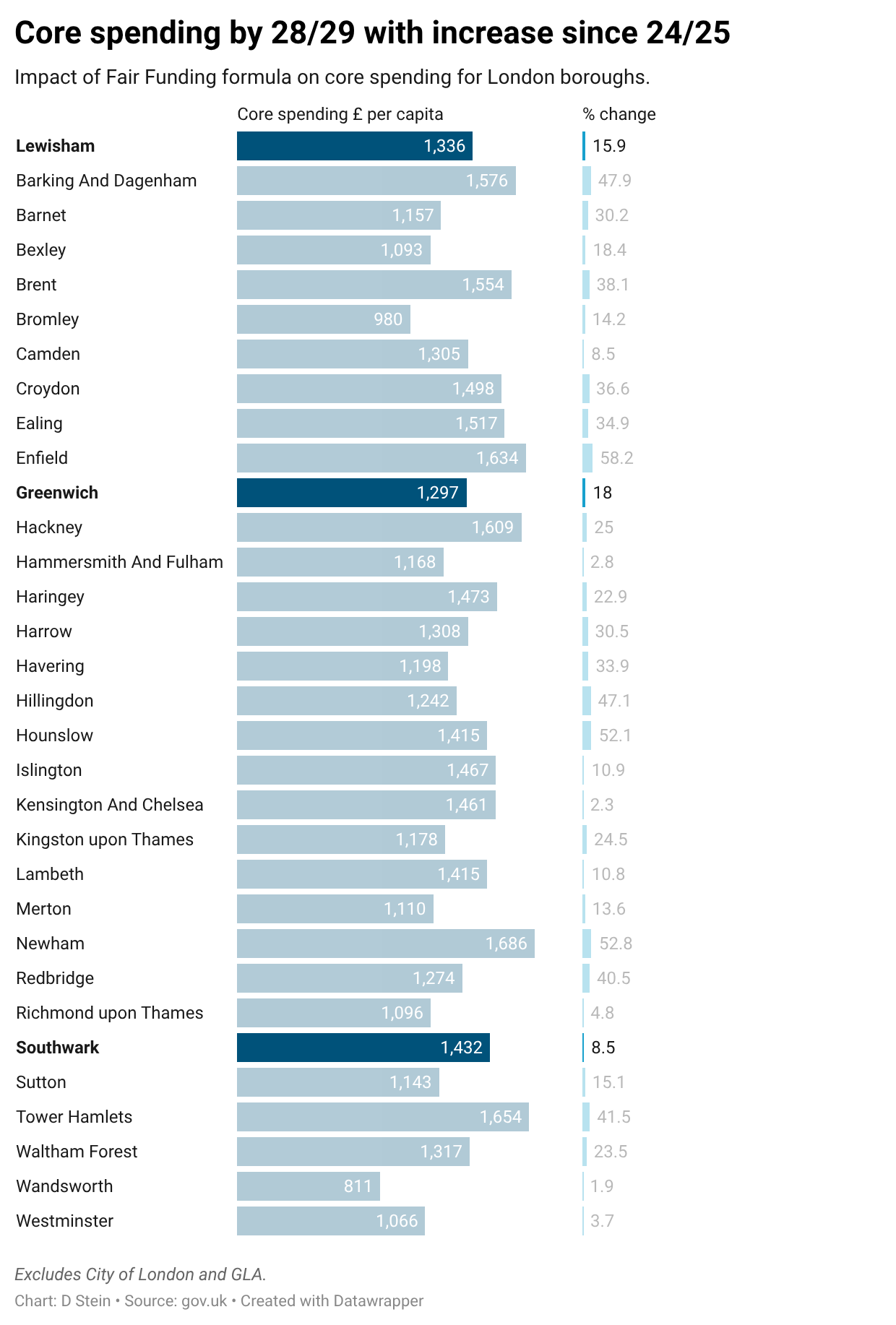
Under the new formula, Lewisham council will get an increase of 15.9% over the three years.
Councillor Amanda De Ryk, Lewisham Council’s Cabinet Member for Finance, Resources and Performance told Salamander that the council was still working to understand the full impact of the local government funding settlement, which will feed into the the council's draft budget.
“While we’re pleased by some changes, including the shift from annual funding announcements to a three year settlement, we still face real financial challenges," she said.
"The historic underfunding of councils, along with increasing demand and rising costs of delivering services, means we’re still facing a real terms cut to our budget and will need to find significant savings to make sure we can continue to balance our budget.”
Councils get their core funding from a combination of government grants, council tax and a proportion of business tax.
They need the new figures to confirm their budgets for 2026-27, their service provision and to set council tax bills in April.
Lewisham council confirmed that even if they raised council tax by 5% each year - the maximum that is generally allowed and above the rate of inflation - the council's core spending would not keep up with inflation, across the three years.
The council will meet to approve the draft budget on 11 February.
Austerity hit poorest areas hardest
During the 2010s, government funding to councils was cut by 46%. Institute of Fiscal Studies (IFS) analysis shows that these cuts "fell hardest on poorer areas"; the most deprived councils, including London councils, were most affected.
Although there was some increase in funding from 2019 - 2024, it did not recover to 2010 levels, and the IFS reported in 2024 that spending was still 18% lower per person in real terms.
Many councils are now in severe financial difficulty and debt, and rising numbers requesting Exceptional Financial Support from the government.
Winners and losers across London
Alison McGovern, the local government minister, announced in November 2025: "This government is taking the tough decisions to create a fairer, evidence-based funding system.
"This means that poorer local authorities that have been unable to generate as much funding through local tax will finally receive the funding they deserve."
The formula broadly takes into account the index of multiple deprivation scores, which were updated in October 2025.
The decision to include housing costs in measures of deprivation has had a significant impact in London, resulting in a huge variation in funding across different boroughs.
Support independent, local news. Become a supporter or leave a tip.
Enfield council receives a 58.2% increase over the three years, the highest percentage increase across London.
Lewisham received a modest 15.9% increase, while Wandsworth receives the lowest increase at 1.9%.
Looking at the resulting core spending per person, Enfield, Hackney, Newham and Tower Hamlets will have spending power above £1,600 per person, by 2028-29, while south London boroughs come out several hundred pounds below this.
London Councils, the collective of London boroughs and City of London, report that one in four Londoners are living in poverty, once housing costs are taken into account.
Homelessness emergency and risk to finances
The group confirmed that temporary accommodation is the biggest financial risk that boroughs face, with 210,000 Londoners homeless and living in temporary accommodation.
Although the government pays to subsidise temporary accommodation, this level has been frozen since 2011.
Councillor Will Cooper, Lewisham's cabinet member for Better Homes, Neighbourhoods and Homelessness, reported to last year's budget setting meeting that the forecast charge to the council to bridge this gap for 2024/25 was £29.5m.
This figure is increasing every year as rents rise.
'Turning the page on a decade of cuts' - really?
Financial risks also spread between different public sector organisations, in areas such as adult social care or emergency mental health provision.
Lewisham council pointed to areas where the council has historically worked closely with public sector organisations including the NHS or the Police, noting that their financial constraints have an impact on the council, which often has to provide the backstop service.
Steve Reed, the minister for Housing, Communities and local government, (who replaced Angela Rayner in September) announced the new allocations with a Panglossian vision: “This is a chance to turn the page on a decade of cuts, and for local leaders to invest in getting back what has been lost – to bring back libraries, youth services, clean streets, and community hubs.
"Today we’re making sure every community has the funding they need to succeed.”
But Lewisham's experience is that we are still far from getting back to those sunlit uplands.
Sign-up for our free weekly newsletter - Salamander News in your inbox