Gail Bradbrook: 'true community' and building the Lifehouse
Dr Gail Bradbrook, co-founder of Extinction Rebellion, kicked off the green strand of the Telegraph Hill Festival by introducing the Lifehouse model for community resilience in the face of environmental crisis.
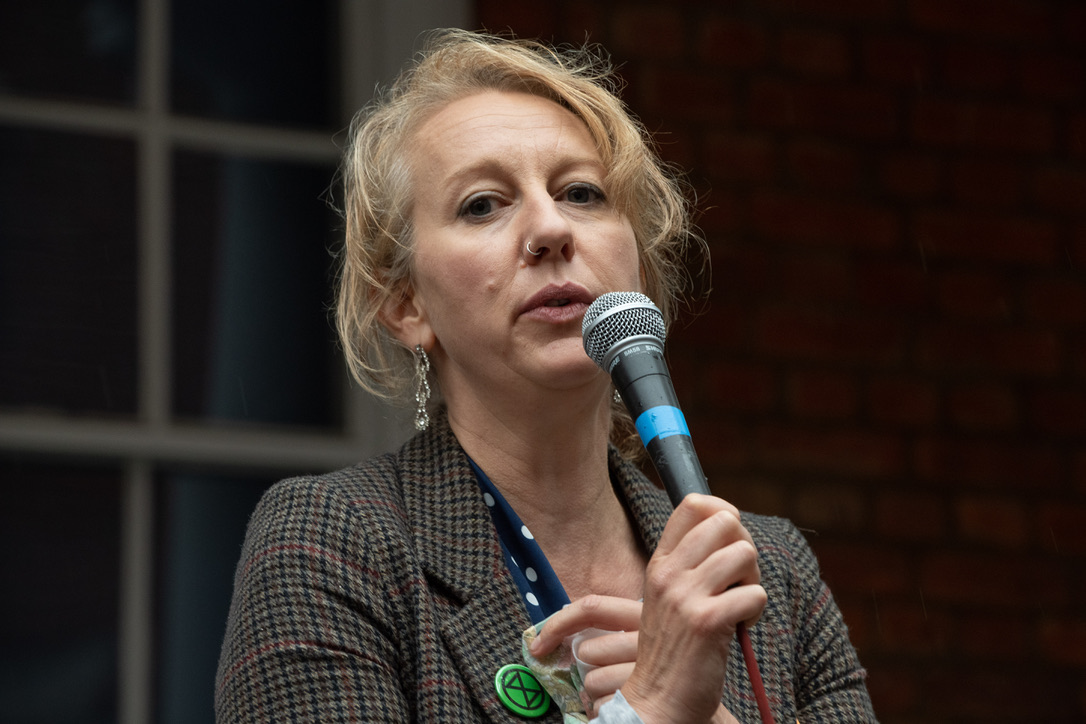
“Whatever the problem, community is the answer,” was Dr Gail Bradbrook’s key message at the event held at The Somerville in New Cross on 14th March. Some 60 people gathered at the popular community hub to hear Bradbrook, one of the most radical voices in the climate and social justice movement today.
Not one to sugar coat humanity’s prospects, Bradbrook was met with rapt attention as she talked about the combined threats of rising fascism and food systems failure in the face of accelerating climate change.
A molecular biophysicist with a long history of political engagement (she joined the Green Party aged 14), Bradbrook is best known for co-founding the environmental and social movement, Extinction Rebellion (XR), which crashed into public consciousness in 2018 with its audacious and colourful ‘raise the alarm’ campaign to boost awareness of the climate crisis.
Lewisham was one of the first London boroughs to declare a climate emergency.
Her more recent work has been to develop a national model of community resilience called the Lifehouse that is currently being trialled in Stroud, Gloucestershire, her hometown.
The moniker was taken from American urbanist Adam Greenfield’s book: Lifehouse: Taking Care of Ourselves in a World on Fire, which Bradbrook highly recommended. More on that later.
She quoted a 2025 Commission report to Parliament that concluded with the statement, “preparations for climate change are inadequate.”
She asked the audience how many of them have followed EU guidelines to stockpile three days' worth of food, water and other essentials. A smattering of hands went up.
Harrowing statistics and scenarios were presented, including the potential collapse of the Atlantic Meridional Overturning Circulation (AMOC). Such a collapse would lead to the terrifying prospect of off-the-chart sub-zero temperatures and far hotter summers "eliminating the possibility of growing food in the UK".
Reiterating the XR slogan: “No one is coming to save us,” Bradbrook urged the audience to recognise the power of communities to support one another since “the state is unlikely to help”.
I wasn’t the only one in the room eager for second half of Bradbrook’s talk. What do we do?
The Lifehouse model
The Lifehouse, explained Bradbrook, would comprise a network of like-minded people, organisations and communities based on three pillars: togetherness, resilience and power, which to be effective must be based on a legitimate mandate.
This mandate is created through participatory democracy that gives everyone a voice mediated through multiple channels like civil society groups, mutual aid networks and parish and town councils, all acting on behalf of the community and mutually enhancing one another.
Bradbrook presented Venn diagrams illustrating how this might look like at a street, ward and local area level. How such a participatory democracy would interact with political, social and cultural contours of each locality and region is yet to be determined, but the Lifehouse model is there to be developed and tested.
“We must come at this with our relevant experience and well as some humility,” she said. "It's about trying things out, learning and repeating what works.”
She added that to work, the Lifehouse model must be a playful coming together, a return to “true community” echoing the message in Greenfield’s book that the act of working collectively for the common good will help us feel more fulfilled, joyful and purposeful.
“As someone once said to me ‘people are your only real pension pot’,” said Bradbrook. “We must invest into our collective well being… things are falling apart, but this is also an opportunity to build something new.”
The enormity of the challenges was a lot to absorb, but the audience questions tended towards the practical such as how do we map our local area for food-growing, overcome fragmentation and get groups working together to ensure inclusivity - all demonstrating a commitment to making such a project work.
Launch of Sustainable Lewisham directory
These questions were a natural segue into the next session at The Somerville, a Green Networking event, which saw the unveiling of the new Sustainable Lewisham Directory which lists dozens of organisations in the borough working on environmental sustainability and community resilience.
But before then we sat down to a tasty supper of baked rice and chickpeas. Food for thought, talk and action.
Jo Bedingfield lives in Lewisham and is member of Lewisham XR.
Telegraph Hill Festival green strand events run until 29 March. Full listings on Salamander Events.
Sign-up for our free weekly newsletter - Salamander News in your inbox