Deptford Park: 'Don't we deserve clean air and greener streets?'
In a ward where 63% of households have no access to a car or van, residents in an area that was excluded from Lewisham council's Sustainable Streets Programme ask why the council abandoned its vision.
"How did the Sustainable Streets initiative evolve into a car parking permit initiative?
"Don't we all deserve clean air and greener streets?"
Martin North from Scawen Road, next to Deptford Park, explains that as the Sustainable Streets initiative rolled out across North Deptford, it had a dramatic, negative effect on the streets that were left out.
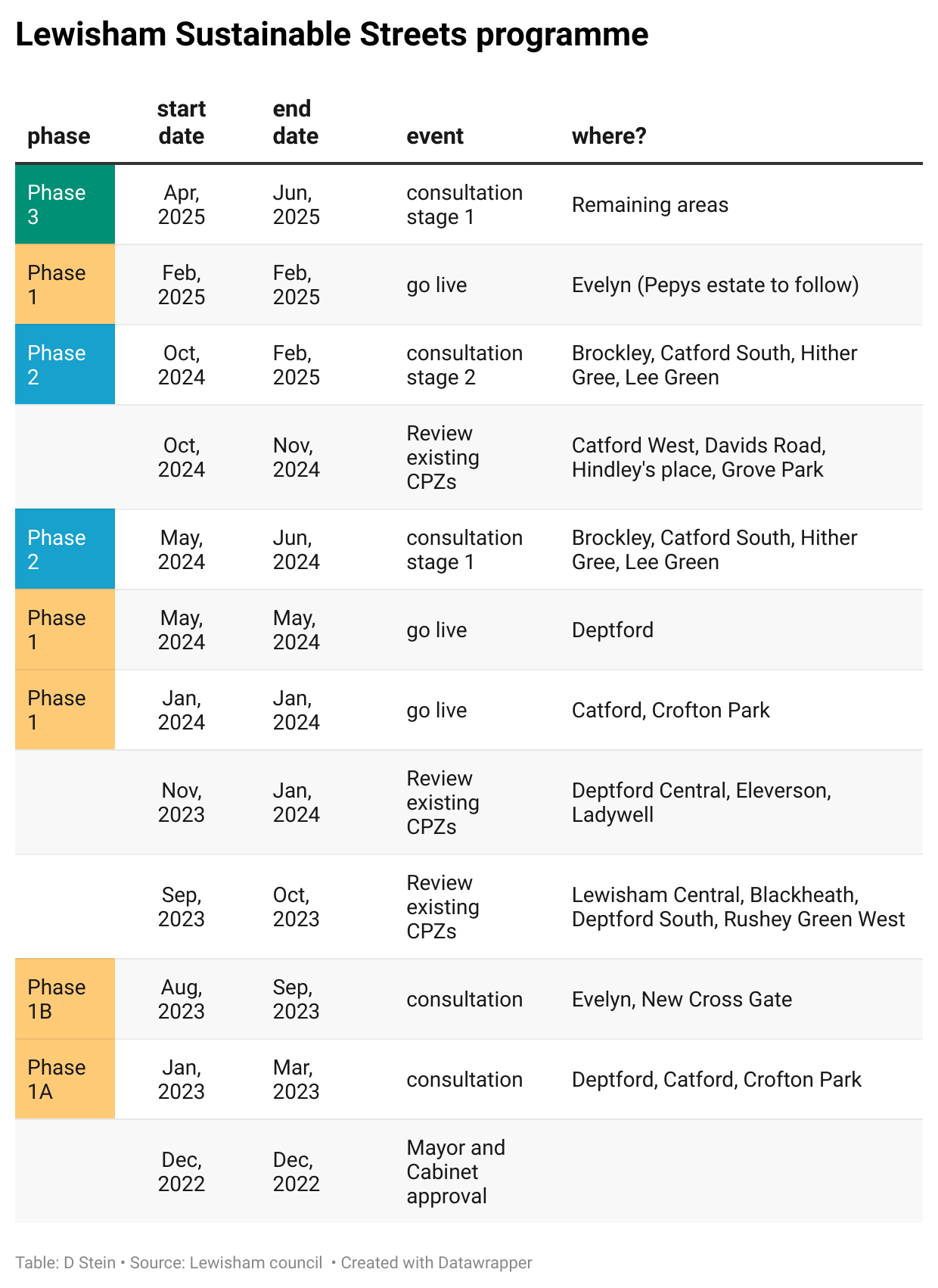
Evelyn ward fell within the first phase of Lewisham council's Sustainable Streets programme, which launched in early 2023.
The council had high hopes for the initiative, which was presented as a basket of measures that would ease parking congestion, improve road safety and bring in electric charging points, cycle hangers and street trees.
63% of households in Evelyn ward have no car or van and this group includes the lowest income residents.
Despite its different efforts to reach people, just 4.6% of Evelyn households responded to the survey.
The council later told residents that its decision to exclude their area depended on the response by that 4.6% to the question: "Would parking permits improve my street?"
"We are now some of the few unrestricted streets in the whole of Deptford" says North.
As soon as the CPZ on neighbouring roads went live in February 2025, residents of Scawen Road and other excluded streets experienced the fallout.
They report that dumped vehicles began appearing the next day. Scawen Road, leading to Twin Oaks primary school became jammed with cars, with double parking and parking on double yellow lines at drop off and pick-up times.
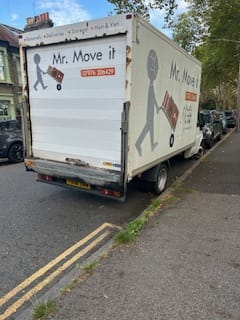
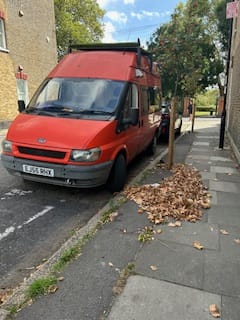
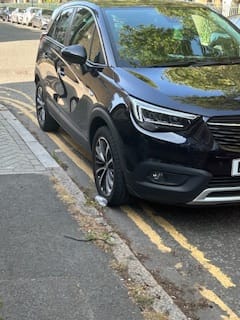
Abandoned vans and parking on double yellow lines. Images: M North
There was a marked increase in litter and fly tipping.
A resident who spoke with Salamander but did not want to be named, due to the ongoing anger towards those who supported Sustainable Streets, reported drivers parking and "throwing their litter out of the window".
Meanwhile, the CPZ streets had become "amazingly clean .. because there's cameras".
High air pollution levels across the area
North raised concerns about high levels of air pollution in north Deptford. The South East London Combined Heat and Power (SELCHP) incinerator and the industrial estate are a stone's throw away.
There is continuous movement of HGVs in the area, adding to the air pollution created by cars and vans.
HGV traffic includes trucks transporting household waste to SELCHP and flat bed trailers delivering to the many nearby construction sites.
Salamander calculates that waste trucks to SELCHP alone are making over 100 journeys past Twin Oaks primary school, along Trundley's Road, every weekday.
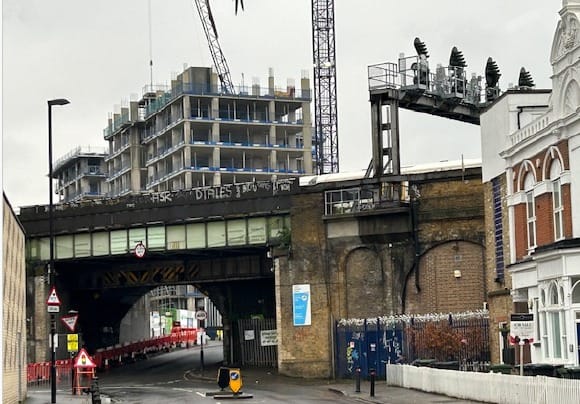
In addition to air pollution from traffic and HGVs, there are concerns about air pollution from the SELCHP chimney, and from the exceptionally high levels of construction work in the area.
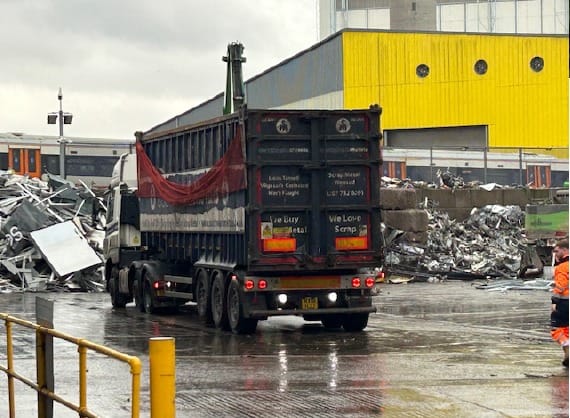

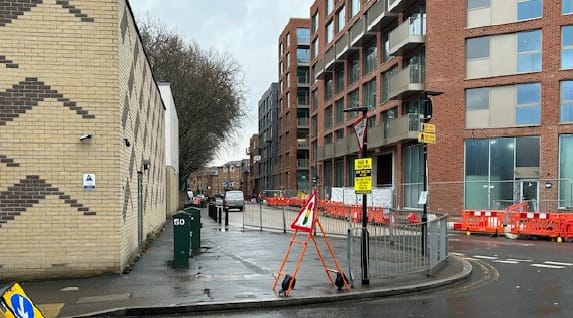

Industrial estate, construction works, SELCHP incinerator and their related traffic add to air pollution around Twin Oaks primary school. Images: M North
Sign-up for our free weekly newsletter - Salamander News in your inbox
The vision .. walking, cycling and greening
Lewisham council's sustainable development select committee reviewed the progress of the Sustainable Streets programme, in June 2025.
Officers described the original aims of "promoting walking, cycling and greening" in the area, improving road safety and accessibility, while also addressing parking concerns.
The overall objective of reducing vehicle use would "have a knock on effect in improving air quality".
They explained how the policy supported the council's Climate Emergency Action Plan, the Active Travel Plan, the Lewisham Local Plan and the London-wide objectives on air quality, net-zero, reducing car journeys and increasing active travel.
However, their ambitions seemed to jar with the reality of the scheme, which officers described early on as "parking controls with added value".
They emphasised that only streets that accepted parking controls would get the "benefits" such as street trees and cycle hangers.
They acknowledged that the programme had "not been without controversy" and that they had adapted the process in response to feedback.
The consultation process is now a two-stage process; if stage 1 indicates support, then it continues to stage 2 which offers designs.
Councillors "disappointed" by programme's reception
Councillor Sian Eiles expressed frustration with the poor uptake across the borough and questioned the council's communications strategy.
The first failure was "continually referring to the scheme as a CPZ" and leading with the parking restrictions, she said.
The council had failed to "lead with the carrot and not with the stick," adding "we have not been good at articulating the benefits."
Louise Krupski, deputy mayor and the cabinet member for environment, transport and climate action, responded.
She reiterated the original objectives, saying that the council had hoped that the greening measures would attract those "who were not car drivers" to the consultation.
They had wanted to say: "The streets are for everyone, not just for car drivers, what would you like to see?"
But she accepted Eiles' points. "I do feel really disappointed, I get it .. however hard we tried, we found it very difficult to attract people who didn't own cars to become part of the conversation".
"It's the nature of the game that its extremely difficult to consult on something like this without it becoming solely about parking, because at the end of the day, that's what the public want to talk about."
Officers admitted that most of the people who responded were drivers.
Councillor James Royston raised similar concerns, asking "how can we seek out quieter voices?"
Echoing the account from residents of Deptford Park, he said the in-person consultations in his area had become "feisty and unpleasant .. but I don't think were a representative sample of our ward."
A motonormativity bias in the consultation?
Officers acknowledged that consultations were polarising. Mentioning decades of experience across different boroughs, they said "the only thing that's more polarising than paying for parking is telling people where they can or can't drive."
They explained how they struggled to ensure they heard drivers' voices: "We'd like people to say no if they don't want it."
Statements like these, and even councillors' statements eg "what the public want to talk about is parking" seem to show a long-term prioritisation of drivers and their wishes, with an assumption that well-run consultations focus on listening to drivers and their views.
This has been called motonormativity, a term coined by Professor Ian Walker at Swansea University, whose research found that British drivers and non-drivers have developed a widespread and unconscious bias in favour of car drivers.
It means that we ignore or underestimate the negative "externalities" of car driving which affect everyone - these include loss of public space, road accidents, the harms of air pollution and greenhouse gas emissions.
Lewisham's Sustainable Streets programme was aligned with council policies that it has debated and developed over many years, and all residents benefit from those broader objectives.
This could support a changed approach with a presumption in favour, an assumed counting-in of those "quieter voices" who would benefit the most, but have not responded.
Area of high deprivation of Living Environment
Martin North points to the environmental degradation of the area around Deptford Park.
The government's latest index of deprivation shows that the area has a very high level of Living Environment deprivation, which refers to the standard of housing and quality of the outdoor environment.
The area is more deprived in this respect than 88% of neighbourhoods in England, and more deprived than around three quarters of neighbourhoods in Lewisham.
"The council's whole decision was based on a certain number of people saying they didn't want to pay for parking," says North.
"But why impose more environmental disadvantage on an area which is already suffering?
"We've lost our way."
Updated 2 December 2025 10.36 to include reference to index of deprivation
Sign-up for our free weekly newsletter - Salamander News in your inbox