Amanda De Ryk: 'We've built 2000 homes, is that enough? Of course not'
Lewisham Labour mayoral candidate Amanda De Ryk plans 1,200 new affordable homes, a Lewisham Youth Trust and is ready to "speak truth to power" to the Home Office.
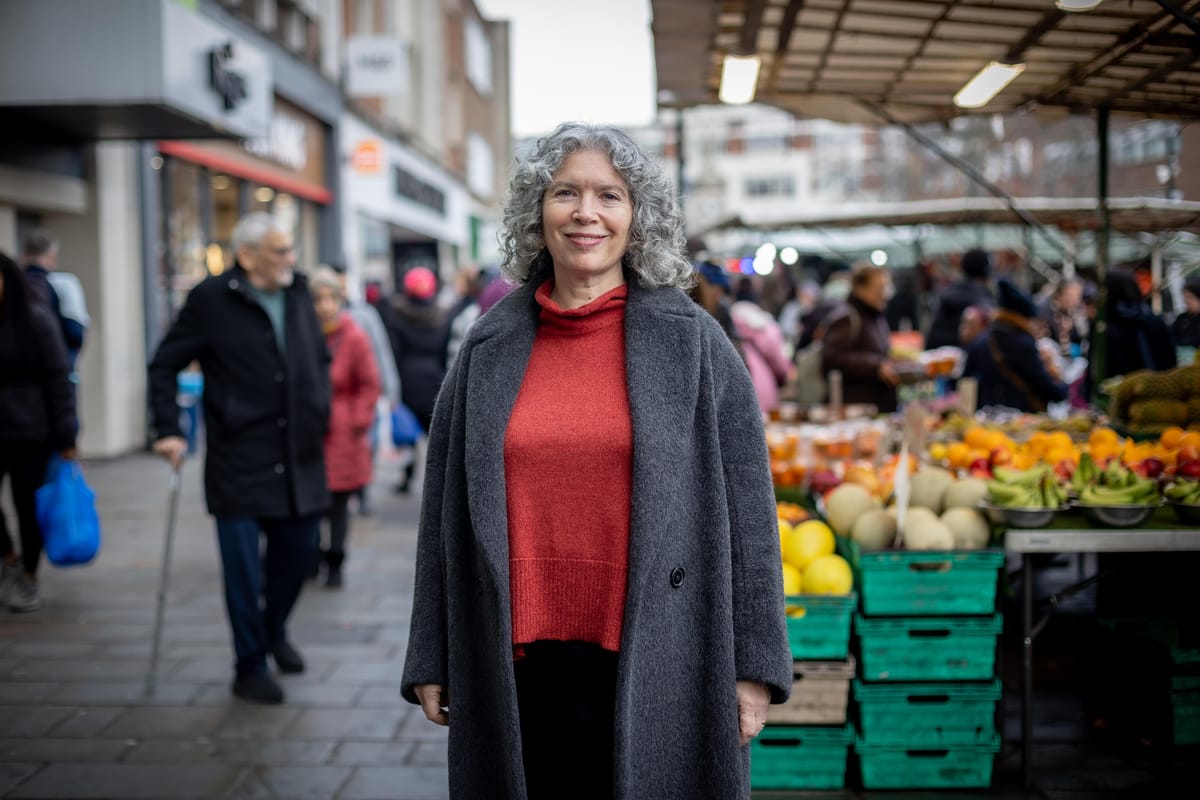
Amanda De Ryk is the Labour Party mayoral candidate for Lewisham.
She has been a Lewisham councillor for 16 years, and Cabinet member for Finance, Resources and Performance for eight years.
Salamander asked Amanda our team's most pressing questions.
Q: There are 11,000 Lewisham households on the waiting list for social housing, but developers don’t want to build it. How will you address this?
A: The amount of people on our housing waiting list - not just ours, on everyone's housing waiting list - feels like a catastrophe ..
But Lewisham has got a good track record of building housing. We've built just over 2,000 since 2018 and we have more in the pipeline.
Is that enough? No, of course not.
When you take into account the pandemic .. the cost of living crisis after the Ukraine war, which really impacted the cost of raw materials, but also the price of skills, the skills shortage .. all house builders, including councils, have been facing national and international headwinds that have made it very, very difficult for us.
In spite of that, Lewisham built [completed] the most council houses last year in the whole of London .. those figures are just about to come out ..
I take issue with the notion that developers don't want to build affordable housing.
It's rather that the grant funding to build affordable housing has for the last 16 years been really constrained, there hasn't been enough money to subsidise affordable housing ..
But the Labour government has just put £11 billion into the GLA to grant fund social and affordable housing .. we will be applying for our fair share and a bit more ..
We have committed in our manifesto to delivering 1,200 new affordable homes, including 800 for social rent.
And we really welcome the new thinking around new build right to buy properties not being available for 35 years, so new builds can't automatically be sold .. the policy has been a disaster ..
But also .. we absolutely push developers to build affordable homes .. it is really important for us that we do that.
Q: There are around 36,000 households in social rented housing in Lewisham. The council has a long history of failure in its handling of repairs. How did this serious neglect come about and what still needs to be done?
A: We recognised that Lewisham Homes - the arms length management organisation that was delivering our council housing - was not where it needed to be, its performance had dropped significantly ..
We brought Lewisham Homes in-house in October 23.
We want every tenant, every person who is living in a Lewisham-owned home, to be living somewhere safe and decent, where the standard of living is something that gives them comfort and well being.
The service was not delivering to that vision and those aspirations so we self-referred to the Housing Ombudsman ..
We have been very transparent about the fact that we are on an improvement journey.
Even the ombudsman acknowledges that the position has improved significantly .. which is recognition of the work that is being done by the teams in a very dedicated and persistent way ..
So whilst we we recognise that there's lots more to do, there are green shoots and tenants are beginning to to feel that in material and real terms.
We are also committed to much more face to face engagement with our tenants ..
I was at an event with .. Lewisham Citizens [UK] and they made a suggestion us that we hold quarterly housing surgeries in schools .. I'm really happy to sign up to that.
You have to create the space where people feel safe, where they feel trusted .. and meet them in that place.
Q: Salamander launched in March 25 and we have reported on many campaigns by local residents opposing intensive high-rise development - all these campaigns have been unsuccessful.
But residents saw Blackheath getting special treatment and many of our readers told us this seems unfair. How do you respond and what's your vision for future development?
A: There is a national housing crisis and we need to build more houses.
In a city like London, there is obviously constrained land availability, and with this, constrained financial viability .. it's very clear that it's more economic to build more housing on smaller pieces of land.
I fully understand people's concerns about high rises .. I was the chair of the Strategic Planning Committee when there was a massive campaign against a 23-storey tower in Catford.
I felt the strength of the people's concern that it just wasn't right for Catford.
And we were able to work with the developer and change those plans, so there was the same amount of housing, it was just differently shaped ..
We are required as local government to deliver a certain amount of housing each year, according to the London Plan.
If you put them in town centres, where there's already densification, that means you're not putting inappropriate buildings in lower rise, more domestic areas ..
There are always trade-offs, but we have to make that case of the need for housing, particularly affordable housing, and we probably don't always get those arguments right, and those communications right ..
The issue with the development in Blackheath isn't about the height, it is partly concern from the community about the economic viability of the village and the impact of that development ..
And so the planning application for Blackheath has been deferred in order to do more work on the economic impact of the development on local businesses, and the loss of parking.
Now, there's a large car park behind the station in Blackheath. If we can't build housing on a car park, then where where can we build it?
However, I think that the case for housing is understood by local people, they're not trying to say no housing, they just don't like this development.
And they've been very, very vocal about about their concerns about the village.
Blackheath performed really strongly as a small economic centre in the borough up until the pandemic, but it has been the slowest of all our town centres to recover post-pandemic ..
It's a special place, but it also drives economic impact for residents, it creates jobs and provides services for local people. So that should be rightly a concern for us as a council.
Sign-up for our free weekly newsletter - Salamander News in your inbox
Q: Vision Zero - There have already been two fatal road accidents in Lewisham this year. 80% of KSI (killed and serious injury) victims are pedestrians and cyclists.
What steps would you take to increase take up of public transport and make cycling and walking safer?
A: My heart goes out to the families and the survivors of those of those accidents.
I attended a meeting with Will Norman, London's Walking and Cycling commissioner. TfL (Transport for London) were there and Louise Krupski, my cabinet colleague, local councillors, residents and members of the public.
We walked all around the area in New Cross [where cyclist Irene Leardini was killed] looking at the constraints and the dangers.
I think everybody acknowledges that the A2 at New Cross Gate as a main trunk road is a really, really difficult space for anyone who isn't in a lorry or on a bus.
We are absolutely committed, both as a council and highways authority to improve safety for pedestrians and cyclists .. it was very clear that Will Norman will put his weight behind any changes that we can bring forward ..
We walked up Jernigham Road, where there's a large secondary school, there's a plan to put a zebra or pelican crossing outside the school.
I've been back there again this week with Louise Krupski and local residents, talking about the viability of that, and what more we can do, for example, to improve visibility.
There is work underway to try to create better cycle lanes, so that cyclists, particularly those who are crossing that road, don't emerge into a chaotic traffic situation ..
I feel the frustration that we can't move more quickly.
It's not a council road, it's much more complicated, particularly with the different bodies that are managing the roads.
But we are working to a really strong active travel strategy, and because that strategy is deemed to be ambitious and deliverable, we've managed to get more funding on the back of it ..
We acknowledge it isn't where it needs to be .. and we're going to do better, work harder and with more determination.
But the reality is that particularly around roads, change .. does take concerted action, you have periods of consultation and also it costs millions, so the funding has to be there.
Q: Cars and SUVs - Car journeys in Lewisham are increasing year on year, and cars are getting bigger. A move to active travel would reduce air pollution, make Lewisham safer, reduce climate emissions and improve health.
Do you support work to increase active travel (walking, cycling and public transport) and reduce car use, and if so how?
My maxim is: build it and they will come. Where we have spent money on better bus routes, the bus journey time reduces and more people use it, because the buses are more reliable ..
We need to make sustainable modes of transport more attractive to people, they need to be more reliable, they need to stay affordable, they need to be regular ..
Obviously, none of us have given up the longed for Bakerloo line extension. Thank you, Sadiq, for the Bakerloop, but we really do still want the tube.
And we have a very strong commitment to improving walking and cycling. We have a healthy streets and healthy neighbourhood strategy that we are committed to implementing, we are trying to make driving unattractive ..
We have a policy where the more polluting cars pay more for our car parks and permits .. we're doing what we can to make larger cars less attractive.
We've put in significantly more crossings and the school streets program is fantastic, I think we may be the borough with the most school streets in London.
That has been one of our most successful policies.
And in terms of the divisiveness that we've seen across London with low traffic neighbourhoods (LTNs), school streets are something that are much more acceptable to the communities in which they exist.
And we are committed to still adapting those .. for example to extend the hours ..
That is our attitude - what works, how can we do more of it?
Q: Education - At KS2, disadvantaged children in Lewisham have achievement 8% below London average for disadvantaged children.
Across all children, Lewisham schools have achievement below the London average at KS2, the gap gets wider at KS4 (GCSE stage) and for academic pathways at KS5.
How will you support schools and teachers to address this?
A: I want to say categorically, I am really ambitious for our young people.
I see that challenge around attainment of young people's goals and aspirations as central to my mayoralty if I succeed at the election.
It is critical that Lewisham's young people have the same chances and opportunities as any other child anywhere else in the country.
There is a kind of London effect where London children do perform generally better than their counterparts across England.
Lewisham is probably closer to the England average than it is to London, but is that good enough? No, absolutely it isn't ..
Our schools are on an improvement journey. All our schools are good or outstanding.
We have the most improved secondary schools in the UK, according to GCSE results .. but we're not complacent ..
I was the cabinet member responsible for the cost of living response .. and I went to talk to our young people as the cost of living crisis was emerging ..
What I heard in that room was, frankly, heart breaking. Children were talking about being hungry at school.
The level of deprivation in the borough is high .. one in three of our children is living in a household where there's not enough money ..
Children sat opposite me and said they were hungry in school.
And so we diverted a huge amount of funding into schools and said, make sure there is free food for children ..
That was a very successful program through the early hardship of the cost of living crisis. But poverty is endemic in London, it's endemic in Lewisham.
And the ill effects of poverty play themselves out through educational attainment ..
We still have in place the HAF program, which is holiday activities with food ..
We're going to start a Lewisham Youth Trust, both to support the organisations that work with our young people all across the borough, but also the young people themselves ..
It will be co-created with young people, it will be a kind of one-stop shop so there'll be an online presence and we will get them to help us design that ..
And behind it will sit support for the organisations that are doing absolutely amazing work for young people at the grassroots.
Q: Immigration, asylum and refugees - Lewisham is a Borough of Sanctuary, but Labour government policies are making it harder every year for refugees to reach this programme.
Do you support your party’s position on immigration, refugees and asylum seekers to the UK and if not, what material steps are you taking to oppose it?
A: I'm very proud that Lewisham was the UK's first borough of sanctuary .. it's an active, huge programme, we've just been re-accredited ..
Lewisham is a very special and diverse place and people that come here contribute to that diversity and that specialness and it is very important that we celebrate that.
I don't think we talk enough about the positive impact that migration has on the economy of the UK, full stop ..
People come here with their energy and they make a contribution to our communities and I stand behind that 100%.
So, yes, there is some tension around some of the recent thinking coming out of the Home Office ..
I took part in a roundtable meeting with Debbie Weeks-Bernard, who is London's deputy mayor for communities and social justice.
We talked to different organisations working with migrants in Lewisham and they raised some significant concerns. .. I believe on the back of that they've written to the Home Secretary and raised some of the concerns, particularly around how long it's taking people to get leave to remain here and some of the perverse impacts ..
For example, you might be entitled to claim benefits, but if you do, that might extend that time period before you can apply for citizenship, which is counterproductive because we don't want to create more need.
We want people to be able to contribute to our societies economically and to become independent.
I've spent the morning at the Lewisham Donation Hub .. when you see examples of such good work and such compassion and support, and then hear the stories of what that support has enabled, then some of the divisive rhetoric that is peddled online, some of the misinformation, even by other parties, other political leaders - it's heart breaking.
And there's no place for it in Lewisham. I will absolutely stand up and put Lewisham first.
And if that means speaking truth to power, then that's exactly what I will do.
Q: Safety and crime is coming up as an issue in London’s local elections.
City Hall has pushed back against misinformation, saying that London has the lowest homicide rate in its recorded history.
In Lewisham, there has been a decrease in many kinds of crime, but there was a tragic increase in homicides, to 10 last year.
Do you believe that social media is fuelling a panic? Do you think Lewisham is unsafe and if so, what is your solution?
Even one death is one death too many, and tragic, both for the victim, but also for all the families connected to those incidents.
And we'll leave nothing undone that can and would change that.
I also think there is a perception of safety problem.
I think those cases, they're awful, they make everyone feel unsafe. They make everyone feel like there are no-go areas ..
I've spoken to hundreds and hundreds of people and this comes up, particularly from older people who feel like the town centres are unsafe for them ..
One of my pledges is to introduce a new, visible "community enforcement team" that will start in the town centres ..
We have new powers as the council, we have a public space protection order, which means that we have the ability to intervene where there's antisocial behaviour.
I think that, that a lot of the perception of safety is around quite low level antisocial behaviour. When I say low level, I'm by no means excusing it.
But for example, around fly tipping, people feel that a place is uncared for and unsupervised ..
We have had a massive crackdown on fly tipping, but we are still at the stage where as fast as we can clear up, somebody's dumping more .. that's a big piece of work for the next administration.
We will pilot the patrols, we hope that visibility of those will help residents feel safer.
We hope that will deter some of the some of the antisocial behaviour like shoplifting, which also really upsets people .. and puts businesses in peril ..
There is not one measure, one lever that you can pull that will solve this .. particularly around the deaths .. these are complex social forces at work.
We have an award winning youth justice team, and they work in a kind of public health trauma informed way, which I think is absolutely critical ..
We need to support the work they are doing, to understand and make sure that that as a society we we are protecting our young people and others.
Q: The NEB briefing from scientists to MPs in November 2025 tried to raise the alarm about climate and nature breakdown, and how we need to mobilise from government level down.
The collapse will profoundly affect the lives and futures of everyone in Lewisham, particularly younger people.
As mayor, you will have a powerful platform. How will you use it to help bring about the transformation that we need to address these linked crises?
I'm concerned in my own right, but I'm also concerned as a parent of young people that will inherit this crisis, and hopefully not when it's too late.
But that's the fear .. that we are either reaching or have reached a tipping point, where it's not a looming crisis, it's happened and it's now.
As a council, we have been very committed to doing things that will alleviate climate change. We're recognised nationally for that work, we were in the top 2% of councils for climate action.
We were one of the first councils to declare a climate emergency .. and we have backed that with action.
We've got a really good retrofit programme. We've done about 560 of our social housing units. And we've got funding to do over 1,000 in total ..
My understanding is that most of the [council's] carbon is emitted by buildings. So it's an intentional thing to actually change the way buildings work, in order to prevent those emissions.
And also .. that means that housing is cheaper, more affordable and more sustainable for our residents as well ..
In terms of active travel, healthy neighbourhoods, all of these programmes come together in a concerted way.
We brought Beckenham Place Park back into use. We view our parks through that lens of .. these are green lungs, they're nature reserves, we are doing our absolute best to increase biodiversity in our public spaces.
And we're creating SUDS .. which you'll have seen around the borough, these kind of mini rain gardens, which have lots of different impacts.
They help with the biodiversity, they help slow the traffic down, and they also capture water ..
So it's a concerted action, bringing together different strands of the council and working differently.
In my portfolio, we divested our pension fund away from fossil fuel companies ..
We were able to to divest away from climate harming investments, because it also made financial sense to do that ..
We're not just doing these things because it makes sense for the climate, we're doing it because it makes sense, full stop.
Please support independent community news. Subscribe or leave a tip