Hospital heat pump project starts on Ladywell Fields nature conservation site
Lewisham and Greenwich NHS trust will drill test boreholes for its ground source heat pump project in the designated nature conservation site (SINC) next to Lewisham hospital.
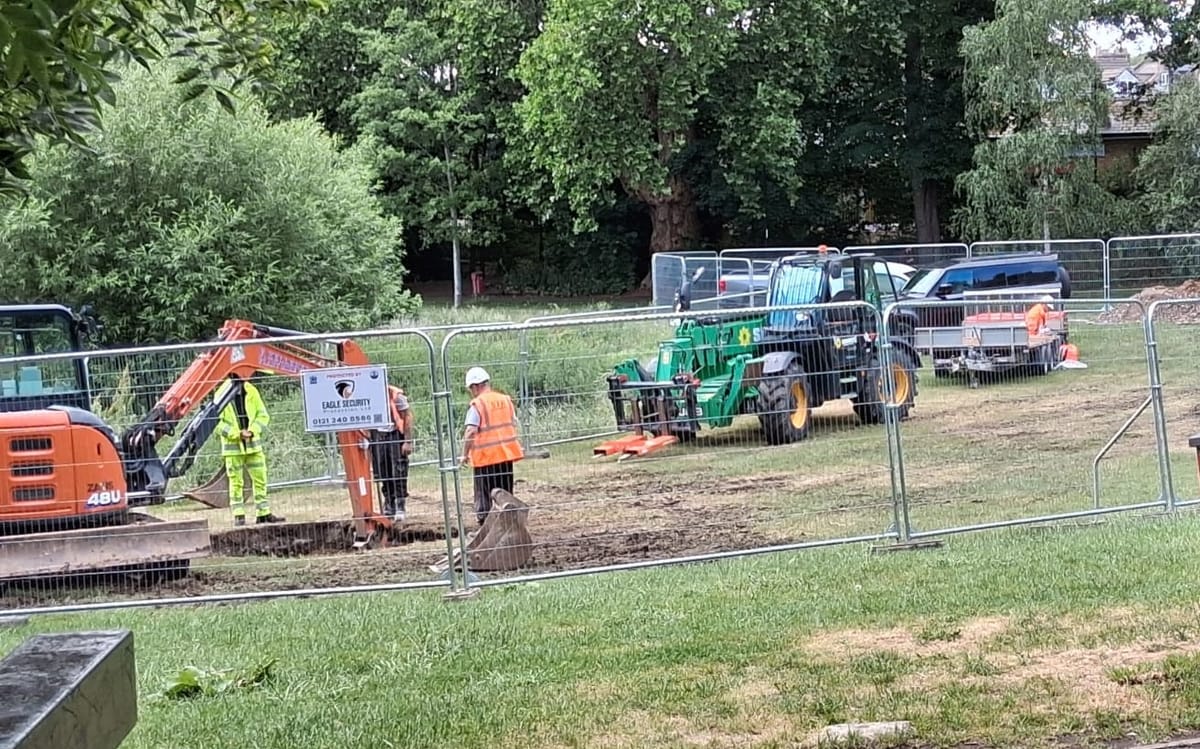
Wednesday saw the start of Lewisham and Greenwich NHS Trust’s work to determine whether its plans for an ‘open loop ground source heat pump scheme’ are viable. The heat pump will replace the hospital’s 1970s gas boiler system.
The project is being run by the Department for Energy Security and Net Zero (DESNZ) which has provided almost £18m of the total £25m budget.
The project will be run by DESNZ finance firm Salix, and contractors on the ground include Veolia, the giant French waste firm which manages the incinerator in Deptford.
The drilling equipment has yet to arrive, but the picture below shows the progress so far in the park near Ladywell Road, as of Friday afternoon.
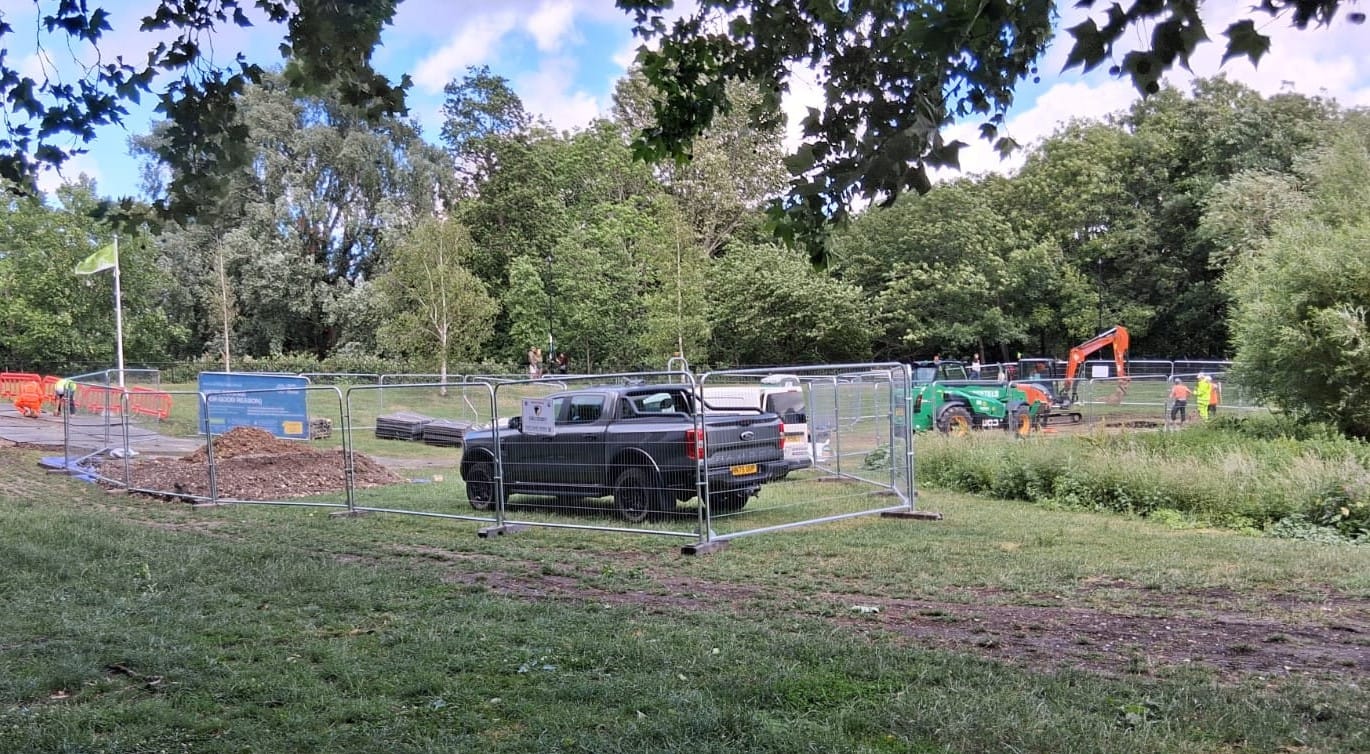
Over the next 10 weeks the planned works will involve drilling two deep abstraction/injection boreholes (90 metres in depth), alongside two shallow observation boreholes (10 metres in depth).
After drilling, the contractors will develop wells.
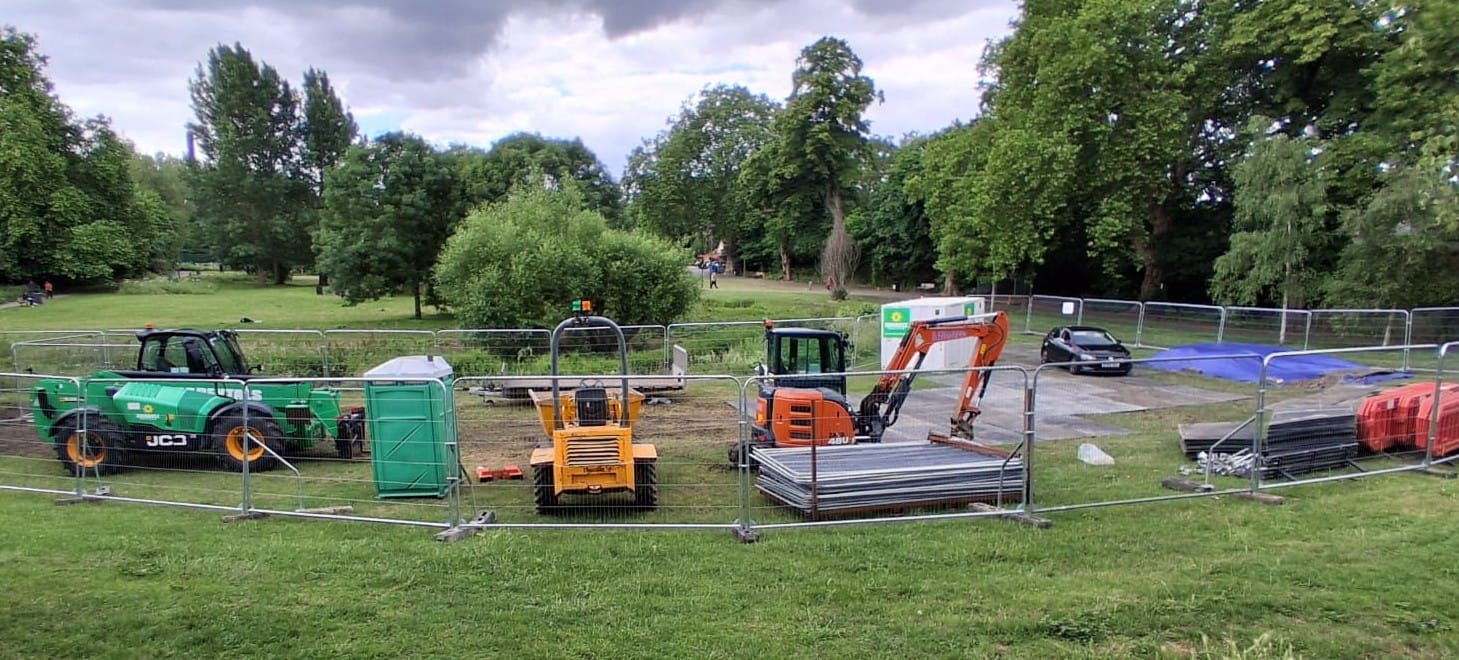
In addition to the location at the north end of the park near Ladywell Road, further drilling will also take place in the north field, close to the children’s playground.
Track matting will be laid between the two work areas for the duration of the work, for moving the heavy equipment between them.
The newly opened Fields café lies between the two drilling sites.
The site notice states that works involve pumping tests, groundwater monitoring and sampling.
If the project goes ahead, six more pairs of boreholes will be drilled in the park.
The project plans to extract water from the chalk aquifer under the park from four of the boreholes near the athletics track, run the extracted water through heat exchangers, pipe it back across the Ravensbourne river and through the north field then reinject water into the four boreholes at the north of the park.
A spokesperson for the trust said that the aim of the 10 week test period is to "determine whether the project is technically viable".
Risks to ecology of the park and the chalk stream
Work to restore nature in the park began in 2007-08 with a project which brought the river into the centre of the north field.
Following this, over £2m was invested by the London Development Agency, which brought the park up to the level of a Borough Site of Importance for Nature Conservation (SINC).
It has held this status since 2016 and is recorded as a SINC in Lewisham's 2025 Local Plan.
This means that it is continually being developed to support biodiversity, including endangered plants, insects and wildlife and deserves special protection.
An open loop ground source heat pump which involves drilling, and continuous water extraction, transport and reinjection into the park seems a surprising decarbonisation choice for Lewisham hospital.
There are alternative options for decarbonising heating systems which it seems could have been carried out on the trust's own grounds, using other types of ground source heat pump or air source heat pumps.
Salix described the planned project as "ambitious and complex", and its £25m price tag bears that out.
However, no explanations have been offered of why this particular energy-efficiency project, with its risks to the park, is being pursued.
The trust says it has carried out surveys for ecology, groundwater and arboriculture during the feasibility phase of the project, but refused our request to see them.
It also refused our request to see the Environment Agency approvals.
It would not commit to when or if these documents would be made available, only saying that if the project proceeds "relevant documentation would be made publicly available as part of any formal planning process by the council".
Lewisham council has given permission to the trust to proceed with the project and a spokesperson said the council had been working with the trust since 2024 and sits on the project board.
However, they would not confirm whether the council had done any work to assess the risks to the park, the Ravensbourne river, the users, wildlife, ecosystems nor what assurances the trust has given to the council.
The spokesperson confirmed that "responsibility for risk assessments sits with the trust as the project sponsor".
Support local independent journalism from just £2 per month or leave a tip.
What happens after 10 weeks' testing?
The trust confirmed that if the viability testing is successful, there would be “further design development and assessment (which) would be subject to full statutory approvals.”
Finally, the trust will submit a planning application to Lewisham council "likely in Autumn 2026".
The council spokesperson confirmed that at this point "any relevant reports would be made public through the planning process where not commercially sensitive, and are reviewed by council teams, external experts and Salix."
It is clear that by the time we get to the planning application stage, the key decisions about the chosen technology, and the use of the park, stream and aquifer, will have been made.
Lack of public engagement
There has been almost no public engagement about the project, which the trust and the council have advised will come later.
The trust told us that their presentation to Friends of Ladywell Fields last December was "met with a lot of positivity".
However, this is not the full picture. The Ladywell Fields user group set out a number of concerns that they said needed to be addressed in a facebook post, a week after the meeting.
The ongoing meetings with the representatives from the group were not public consultation, and the group's offers to share information more widely with the public were resisted by the trust.
Decarbonisation projects don't get a free pass
Decarbonisation projects should be scrutinised as closely as any other type of construction project and where there is disruption for thousands of park users and potentially decades of damage to wildlife and nature, this becomes even more important.
In this case, there seem to be clear, lower risk alternatives for decarbonisation which have been dismissed in favour of this high risk, complex and expensive option, without openness about why DESNZ, Salix or the trust have made this choice.
Louise Krupski, then cabinet member for environment, transport and climate action, told Salamander in December: "As a project it sits very well alongside Lewisham Council’s own efforts to improve its housing stock with significant investment from the government’s Social Housing Decarbonisation Fund."
A similar point was raised by others, that this is essentially a trial of a poorly adopted technology that could be helpful for future projects.
This is not reassuring and raises questions about why a trial should take place in a much loved park and site of nature conservation with a fragile chalk stream, in Lewisham.
Damage to the park has started, the project has begun and its seems that by the time public consultation begins, key decisions will already have been made.
The use of the park, the nature that depends on it and the chalk stream all have a value, but their value will not have figured in the calculations.
Support local independent journalism from just £2 per month or leave a tip.